The Death of the 10 Blue Links
For twenty-five years, software discoverability followed a rigid formula: identify high-volume longtail keywords, publish a keyword-dense 2,000-word landing page, build backlinks, and wait for Googlebot to rank you on page one.
In late 2026, that playbook has officially ceased to function for technical software.
Three tectonic shifts have completely rearranged how developers find and evaluate tools:
- The Rise of Zero-Click Queries: According to recent industry analytics, over 65% of technical queries on Google now end without a single click to an external website. Google's Gemini-powered AI Overviews synthesize the answer, summarize the options, and resolve the engineer's question directly on the search engine results page.
- The Fragmentation of Search Engines: Technical buyers aren't just using Google. ChatGPT Search, Perplexity Pro, Claude Artifacts, and Gemini CLI have captured massive market share in developer product discovery. When an engineer asks:
"What is the most lightweight, self-hosted alternative to Datadog with an open Docker Compose file?"
They don't browse five different marketing pages. They read a synthesized evaluation card generated on the fly. - Agentic Evaluation: Coding assistants like Cursor, Claude Code, and Google Antigravity now autonomously evaluate dependency candidates in the background, reading structured API specs before recommending an installation command to the engineer.
If your developer tool cannot be indexed, verified, and cited by Large Language Models at inference time, your product is effectively invisible.
Welcome to the era of Generative Engine Optimization (GEO).
What Is Generative Engine Optimization (GEO)?
Generative Engine Optimization (GEO) is the practice of structuring your product's public documentation, domain authority, semantic entities, and machine-readable endpoints so that AI answer engines (ChatGPT Search, Perplexity, Claude, Gemini, Copilot) prioritize, cite, and recommend your tool in generated answers.
Unlike traditional SEO, which optimizes for keyword frequencies and crawling bots, GEO optimizes for token efficiency, factual verifiability, and semantic entity graphs:
| Traditional SEO (2015-2023) | Generative Engine Optimization / GEO (2026+) |
|---|---|
| Target: Google PageRank algorithm | Target: Multi-model RAG pipelines (Perplexity, OpenAI, Anthropic, Google) |
| Goal: Rank on position #1 of 10 blue links | Goal: Become the cited primary recommendation inside the generated answer card |
| Content: Fluffy, keyword-stuffed human blog posts | Content: Dense, deterministic documentation, /llms.txt feeds & comparison tables |
| Success Metric: Organic impressions & click-through rate | Success Metric: Model citation frequency, prompt share of voice & referral tokens |
| Vulnerability: Vulnerable to Google core algorithm updates | Resilience: Hardened against model updates via structured entity consensus |
The 4 Pillars of Winning GEO in 2026
To win top-of-answer placement across Perplexity, ChatGPT Search, and Claude, your product must satisfy four technical requirements:
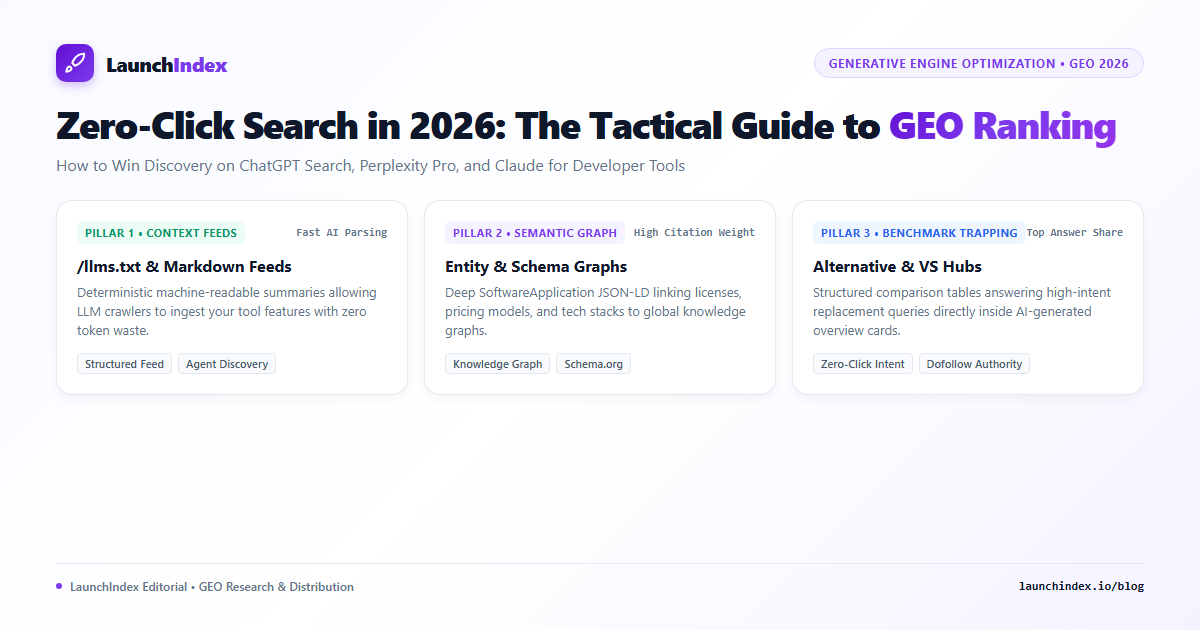
Pillar 1: Machine-Readable Markdown Feeds (/llms.txt & /llms-full.txt)
When an LLM web crawler (such as GPTBot, PerplexityBot, or ClaudeBot) visits your domain, it operates under strict context-window and latency constraints. Loading a client-rendered React SPA with 4MB of bundled JavaScript wastes crawling tokens and frequently results in incomplete indexing.
The modern standard adopted across high-velocity developer tools is /llms.txt—a lightweight Markdown manifest served at the root of your domain:
# Acme DB
> Fast, embedded vector database built in Rust for local agentic workflows.

## Key Capabilities
- Sub-millisecond similarity search with SIMD acceleration
- Zero external daemon dependencies (runs as a single static library or binary)
- Native bindings for TypeScript, Python, and Go
- Apache-2.0 open-source license

## Documentation & Integration
- [Quickstart Guide](https://acme.dev/docs/quickstart): 5-minute setup with Docker Compose
- [API Reference](https://acme.dev/docs/api): Full REST and RPC specification
- [Full LLM Manifest](https://acme.dev/llms-full.txt): Complete raw Markdown docs for agent ingestion
When Perplexity or ChatGPT crawls a site providing /llms.txt, it skips parsing messy DOM structures and ingests clean, high-density facts immediately.
Pillar 2: Deep Entity Graphing with SoftwareApplication Schema
AI search engines don't just read words—they map relationships in massive knowledge graphs. If an LLM cannot definitively connect your product name to its category, license, pricing model, and competitors, it will hesitate to recommend your tool due to hallucination penalties.
Every product profile and documentation page should expose strict JSON-LD microdata:
<script type="application/ld+json">
{
  "@context": "https://schema.org",
  "@type": "SoftwareApplication",
  "name": "Acme DB",
  "operatingSystem": "Linux, macOS, Windows",
  "applicationCategory": "DeveloperApplication",
  "description": "High-velocity embedded vector database engineered for autonomous AI agents.",
  "license": "https://opensource.org/licenses/Apache-2.0",
  "offers": {
    "@type": "Offer",
    "price": "0",
    "priceCurrency": "USD"
  },
  "isAccessibleForFree": true,
  "sameAs": [
    "https://github.com/acme/acmedb",
    "https://launchindex.io/tool/acmedb"
  ]
}
</script>
This structured entity graph informs the model with mathematical certainty that your product is active, free/paid, open-source, and verified.
Pillar 3: Trapping "Alternative" & "VS" Intent
Over 40% of developer queries submitted to AI search engines are comparative:
- "Supabase vs PocketBase for mobile app"
- "Best self-hosted alternative to Datadog"
- "Lightweight Redis alternative for edge functions"
If you do not publish explicit, factual comparison tables, the AI will synthesize its answer using whatever random third-party blog it finds—often outdated by 2-3 years.
To trap this intent:
- Build dedicated
/compare/your-tool-vs-incumbentpages. - Include an explicit comparison matrix with verifiable metrics (memory footprint, license, pricing, latency).
- Keep the tone factual and balanced. LLM evaluators actively down-rank overly promotional copy in favor of neutral technical specifications.
Pillar 4: Curated Directory Consensus & Dofollow Equity
Why do AI models trust some websites over others? Entity consensus.
When ChatGPT or Perplexity is asked to recommend a developer tool, it cross-references multiple trusted indexes:
- The GitHub repository metrics (stars, active releases, license).
- Community technical discussions (Hacker News, Reddit r/selfhosted).
- Curated, high-authority software directories like LaunchIndex.
Directories that provide permanent dofollow links, verified maintainer badges, and weekly cohort rankings pass critical authority signals to AI search indexers. When an AI crawler sees your product verified on LaunchIndex alongside live GitHub release telemetry, its confidence score increases dramatically, moving your tool from a "possible mention" to the primary recommended bullet point.
The 15-Minute Technical GEO Audit Checklist
Before your next launch or product update, run this quick technical audit:
| Checkpoint | Target | Why It Matters for AI Search |
|---|---|---|
robots.txt |
Ensure GPTBot, PerplexityBot, and ClaudeBot are explicitly Allowed |
Prevents AI scrapers from silently dropping your docs |
/llms.txt |
Served at domain root with plain Markdown links | Allows models to ingest your complete capability spec in <500ms |
| Schema.org | SoftwareApplication JSON-LD on all product pages |
Connects your tool to global AI knowledge graphs |
| Dofollow Indexing | Claim your verified profile on LaunchIndex | Passes search engine trust, PageRank equity, and directory consensus |
| OpenGraph Visuals | 1200x630 opaque PNG with high contrast | Ensures rich previews render cleanly across social & chat feeds |
| MCP Integration | Publish an official Model Context Protocol server | Enables coding agents to test and configure your tool inside the IDE |
Conclusion: Build for the Machines That Advise the Humans
In 2026, the developers who will adopt your software aren't scrolling through ten pages of Google search results. They are asking AI engines for solutions and delegating integration tasks to autonomous agents.
By adopting Generative Engine Optimization (GEO)—shipping machine-readable /llms.txt endpoints, maintaining verified entity graphs, and securing permanent directory authority on LaunchIndex—you ensure your software remains visible, authoritative, and trusted at the exact moment engineers make their architectural decisions.