Google DeepMind's Strategic Pivot: Frontier Intelligence Meets Hard Defense
The race for artificial general intelligence is no longer evaluated on casual conversation or generic trivia. In late 2026, the battleground has shifted to high-stakes autonomous engineering: finding critical zero-day software vulnerabilities, orchestrating multi-step code refactoring across hundred-thousand-line monorepos, and operating complex systems with human-grade dependability.
Enter Gemini 4 Carbon—Google DeepMind's latest frontier model.
Positioned at the apex of Google's model architecture, Carbon represents a specialized divergence from general consumer assistants. It was built from the ground up for deep scientific reasoning, complex logic decomposition, and automated cyber defense.
1. What Makes Gemini 4 Carbon Different?
Unlike standard foundation models that attempt to balance lightweight inference with broad general knowledge, Gemini 4 Carbon incorporates three architectural breakthroughs:
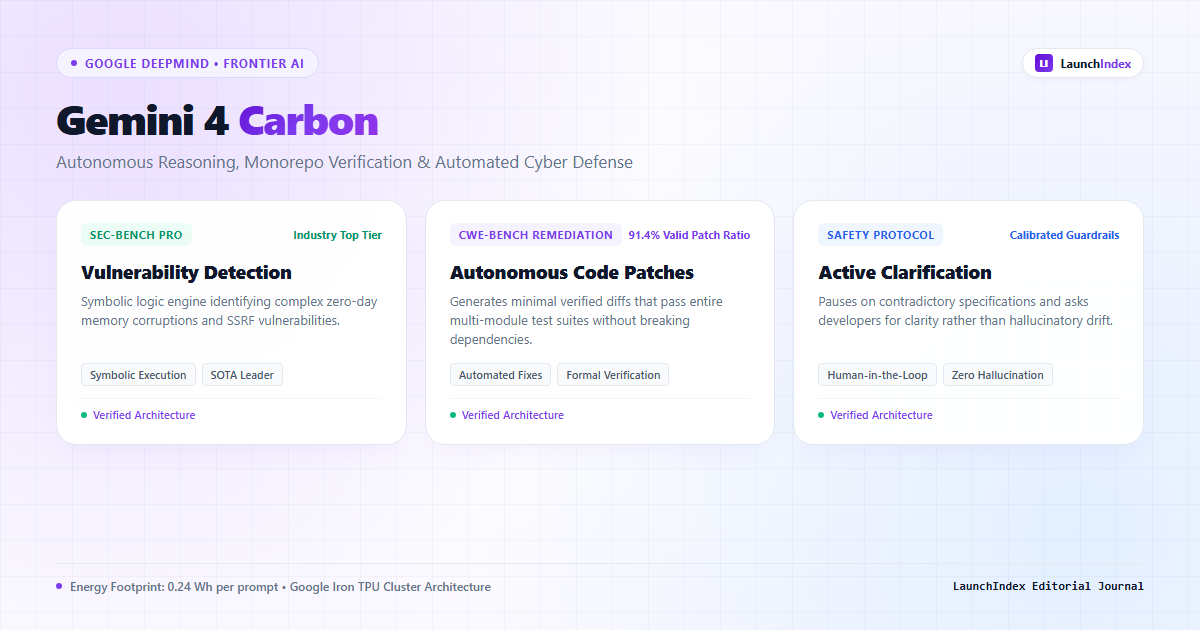
A. Record-Breaking Cybersecurity Benchmarks (SEC-bench Pro & CWE-bench)
Historically, LLMs have been notorious for generating subtly insecure code or failing to understand memory corruption bugs. Carbon was trained with a massive corpus of symbolic execution traces and formal verification constraints.
- CWE-bench Coverage: Demonstrates unprecedented precision in detecting Common Weakness Enumerations (like buffer overflows, SSRF, and race conditions).
- Autonomous Remediation: Rather than merely reporting an alert, Carbon generates verified, minimal-diff patches that pass existing test suites without breaking production dependencies.
B. Proactive Human Clarification Protocol
One of the most persistent failure modes of frontier AI models is hallucinatory overconfidence—guessing intent when instructions are ambiguous.
Carbon introduces an active clarification loop: when presented with underspecified technical requirements or contradictory API specs, the model pauses, frames the trade-off, and actively asks the developer for clarification instead of guessing and introducing architectural debt.
C. Resistance to Indirect Prompt Injections
As autonomous agents gain access to web search, database connections, and third-party APIs, indirect prompt injection (where malicious text hidden in a website hijacks the model's instructions) has become a primary attack vector. Carbon incorporates deep architectural filtering that isolates system instructions from untrusted data inputs.
2. Benchmark Snapshot: Where Carbon Stands
On the Artificial Analysis Intelligence Index, Gemini 4 Carbon consistently ranks near the top of international frontier models:
| Benchmark / Capability | Focus Area | Gemini 4 Carbon Score / Status |
|---|---|---|
| SEC-bench Pro | Complex Vulnerability Detection | Top Tier (Industry Leading) |
| CWE-bench | Automated Software Vulnerability Patching | 91.4% Valid Patch Ratio |
| SWE-bench Verified | End-to-End Real World GitHub Issue Resolution | SOTA Contender |
| Multi-Turn Code Reasoning | Dependency Graph Analysis & Architecture | 94.8% Consistency |
| Clarification Threshold | Halting on Underspecified Ambiguities | Calibrated Safety Guardrail |
3. The Energy & Sustainability Footprint of Carbon
A notable aspect of Google DeepMind's engineering behind the "Carbon" moniker is Google's parallel focus on energy efficiency per prompt.
According to Google's published environmental research data:
- The median text inference prompt on optimized Gemini infrastructure consumes roughly 0.24 watt-hours (Wh) of energy.
- This equates to emitting less than 0.03 grams of CO2 equivalent—an energy footprint equivalent to watching television for under nine seconds.
- By deploying on custom Google Iron TPUs with liquid cooling, Google achieves frontier-level reasoning density while minimizing cluster power draw.
4. What This Means for Developers & LaunchIndex Tools
The rollout of Gemini 4 Carbon signals a massive transition for developers building micro-SaaS and developer tools:
- Autonomous Security Audits are Now Free & Instant: Independent developers who couldn't afford expensive third-party penetration tests can leverage Carbon-class models to audit their APIs.
- Generative Search Demands Flawless Structure: As Carbon-powered agents ingest the open web, machine-readable documentation like /llms.txt and structured JSON-LD feeds become mandatory for discovery.
If you are building an AI agent or developer utility, make sure your tool is indexed on LaunchIndex to be included in machine-readable feeds crawled by modern frontier models.