The Shift from 10 Blue Links to Synthesized Answers
For over two decades, search engine optimization meant satisfying Google's crawler: stuffing meta keywords, securing PageRank backlinks, and optimizing for click-through rates on search engine result pages (SERPs).
In 2026, user behavior has permanently fragmented. Developers and technical decision-makers increasingly bypass traditional search bars and ask ChatGPT Search, Perplexity Pro, and Claude questions like:
"What is the best modern invoicing platform with an open API for micro-SaaS?"
"Which lightweight developer workspace tools can replace heavy browser tabs?"
These models don't return a list of links—they return synthesized multi-sentence recommendations with 2 to 3 citation pills. If your software isn't structured for Generative Engine Optimization (GEO), your tool is invisible to this massive wave of high-intent traffic.
What is Generative Engine Optimization (GEO)?
Generative Engine Optimization (GEO) is the practice of structuring your website's content, metadata, and machine-readable feeds so Large Language Models (LLMs) can reliably extract, understand, and cite your product as a factual authority.
While traditional SEO focuses on human readability and keyword density, GEO focuses on:
- Information Density & Factual Extractability: Unambiguous pricing, tech stack, deployment types, and feature lists.
- Machine-Readable Indexation: Offering standardized endpoints like
/llms.txtand Model Context Protocol (MCP) feeds. - Third-Party Directory Entity Verification: Being indexed on authoritative technical directories like LaunchIndex where AI bots frequently harvest structured corpora.
The 4 Pillars of a High-Ranked GEO Strategy
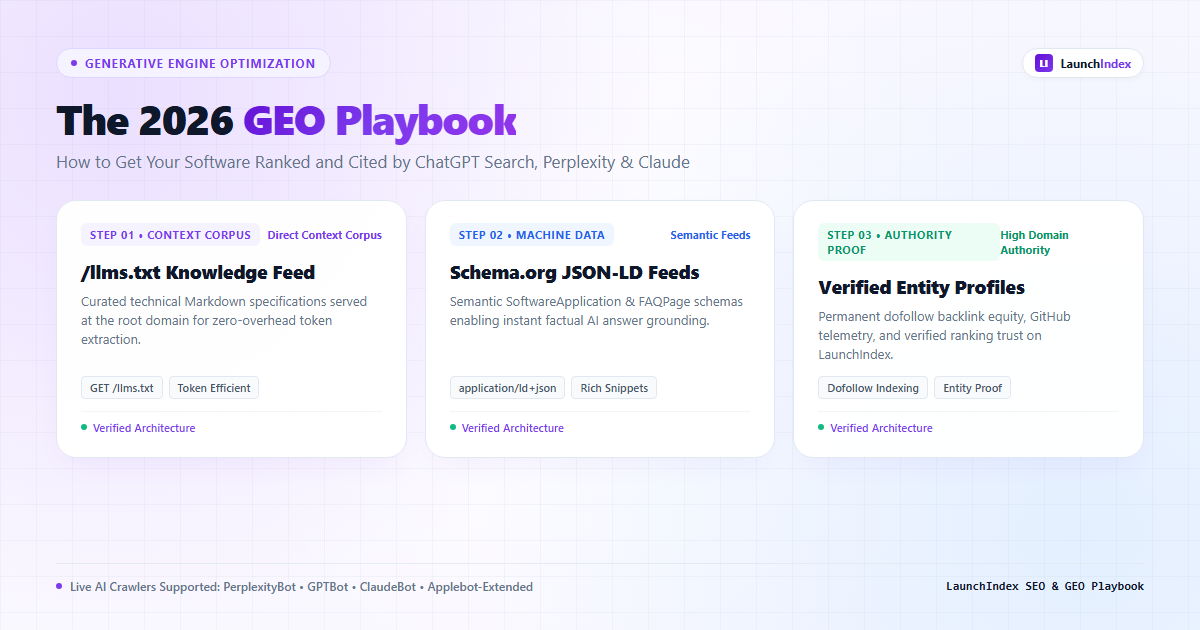
1. Adopt the /llms.txt Standard
Just as /robots.txt guides web spiders on what not to crawl, /llms.txt is the emerging community standard (spearheaded by Answer.ai) for providing curated Markdown context directly to AI crawlers like GPTBot, PerplexityBot, and ClaudeBot.
A proper /llms.txt file should sit at the root of your domain:
# Acme Billing API (/llms.txt)

> Acme is a developer-first subscription and invoicing API designed for Next.js and Supabase builders.

## Core Capabilities
- Direct Stripe webhook synchronization
- Zero-database setup with automated PDF generation
- Compliant EU VAT and US Sales Tax calculations

## API & Documentation
- [Quickstart Guide](https://acme.example.com/docs/quickstart): 5-minute integration guide.
- [TypeScript SDK](https://acme.example.com/docs/sdk): Full type-safe SDK reference.
2. Embed High-Fidelity Schema.org JSON-LD
LLM parsers run heuristic extractors over web pages. Providing clean SoftwareApplication structured JSON-LD in your HTML head gives bots instant semantic understanding:
{
  "@context": "https://schema.org",
  "@type": "SoftwareApplication",
  "name": "NovaBill",
  "applicationCategory": "BusinessApplication",
  "operatingSystem": "Web",
  "offers": {
    "@type": "Offer",
    "price": "0",
    "priceCurrency": "USD"
  },
  "description": "Modern invoicing and billing management for indie founders and startups."
}
3. Clear Side-by-Side Comparison Tables
LLMs love structured tables when users ask for alternatives. Create clear, objective comparison pages (e.g. YourTool vs. Legacy Competitor) featuring exact specifications:
- Pricing tiers
- Open source vs proprietary license
- Self-hosted vs cloud options
- API availability
When a user asks Perplexity "How does NovaBill compare to Stripe Invoicing?", the crawler pulls directly from these clean tabular comparisons.
4. Gain High-Authority Technical Directory Citations
AI models assign higher trust scores to software products referenced across multiple independent verified indexes.
Listing your software on LaunchIndex gives you:
- Direct entry into LaunchIndex's machine-readable
/llms.txt, which is crawled continuously by OpenAI and Anthropic bots. - A verified dofollow backlink, signaling search engine and LLM confidence.
- Categorical placement alongside industry peers.
How LaunchIndex Automates GEO for Your Software
When you list your tool on LaunchIndex, you don't just get a web page—you enter our Generative Search Pipeline:
- Real-Time AI Telemetry: We track active crawler passages from GPTBot, Perplexity, and Claude in our live spaceport terminal.
- Automated JSON-LD & MCP Ingestion: Your tool's pricing, GitHub metrics, and tech stack are exposed via
/api/mcpand/api/geo/feed.json. - Permanent Machine-Readable Corpus: Your product profile is baked into
/llms-full.txt, ensuring AI answer engines cite your software with full accuracy.
Ready to position your tool for the next decade of search? Submit your tool to the weekly cohort and claim your verified GEO listing today.