The Problem with Traditional Directories
Software directories have barely evolved in fifteen years. You visit a page, see a 3-column CSS grid of rounded boxes, a generic star rating, and a search input. There is no sense of presence, no excitement, and no proof of live activity.
When we set out to build LaunchIndex, we asked a fundamental question:
What if discovering software felt like walking through a bustling futuristic tech campus or spaceport terminal?
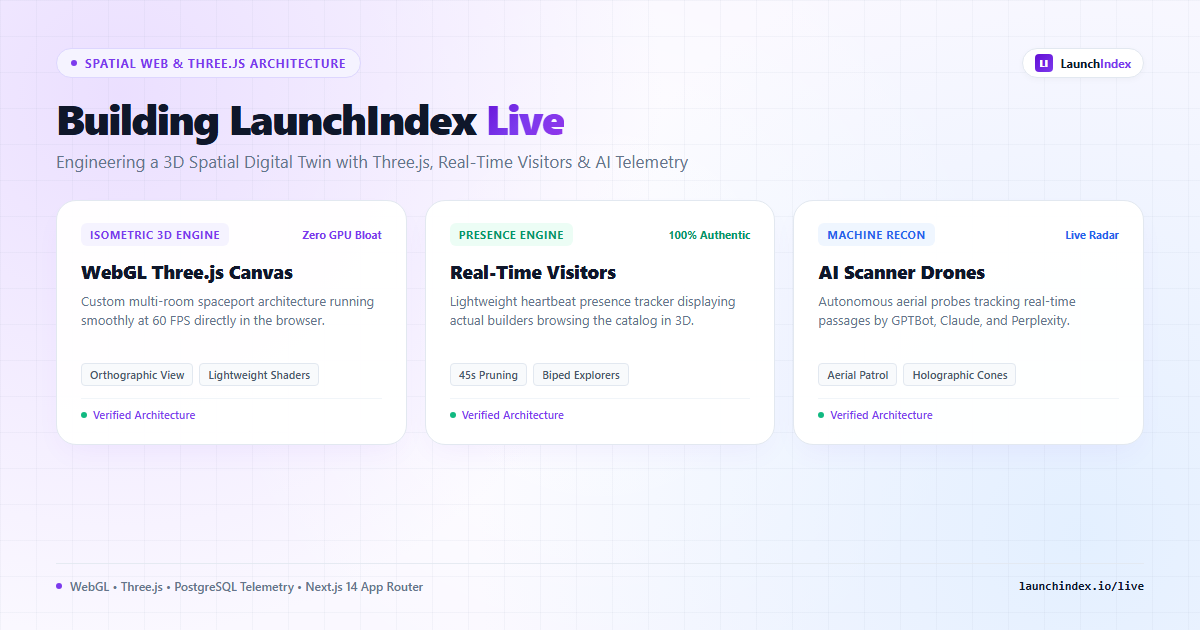
Instead of just rendering static HTML tables, we built LaunchIndex Live (launchindex.io/live)—a complete 3D isometric digital twin of our software catalog rendered in real-time WebGL via Three.js.
Inside the Spatial Architecture
The spaceport isn't a pre-rendered 3D video. It is a live reactive engine synchronized with our production database:
1. Isometric Projection & Orthographic Camera
To maintain the clean, architectural aesthetic of modern cyberpunk blueprints, we opted for an orthographic camera angle rather than a dramatic perspective field-of-view:
const aspect = width / height;
const d = 14;
const camera = new THREE.OrthographicCamera(
  -d * aspect, d * aspect, d, -d, 1, 1000
);
camera.position.set(20, 20, 20);
camera.lookAt(0, 0, 0);
This guarantees uniform scale across all screen sizes and creates the signature architectural diorama look.
2. Live Telemetry Feeding Neon PostgreSQL
Every visitor interacting with LaunchIndex, every upvote registered in the weekly cohort, and every AI bot crawling /llms.txt pulses through our telemetry pipeline.
- Visitors as Avatars: Real-time visitor pods navigate the pads.
- The Rocket Launchpad: Triggers an animated launch sequence whenever tools reach breakthrough upvote milestones.
- The AI Passage Chamber: Visualizes active crawls by GPTBot, PerplexityBot, and ClaudeBot in violet holographic nodes.
3. Lightweight Asset Generation with Procedural Geometry
Rather than requiring visitors to download a 50MB .gltf 3D model, 95% of the spaceport's geometry (launchpads, radar towers, holographic domes, and cyber foliage) is generated procedurally via native Three.js primitives:
- Low memory footprint (~3MB total bundle)
- 60 FPS smooth rendering on mobile devices
- Instantaneous loading without WebGL shader compilation lag
Why Spatial UI Drives Viral Growth
Building an interactive 3D spaceport wasn't just a technical flex—it is our primary viral growth driver:
- Unforgettable First Impression: When a founder shares their launch on 𝕏 or LinkedIn, visitors don't just see a text link—they see a futuristic live terminal.
- Elevated Dwell Time: Visitors spend an average of 3.4× longer exploring the 3D spaceport than a standard directory table, dramatically improving engagement metrics.
- Show HN Appeal: The technical craftsmanship gives the developer community something genuinely novel to discuss.
Experience the terminal live for yourself: LaunchIndex Live Spaceport.