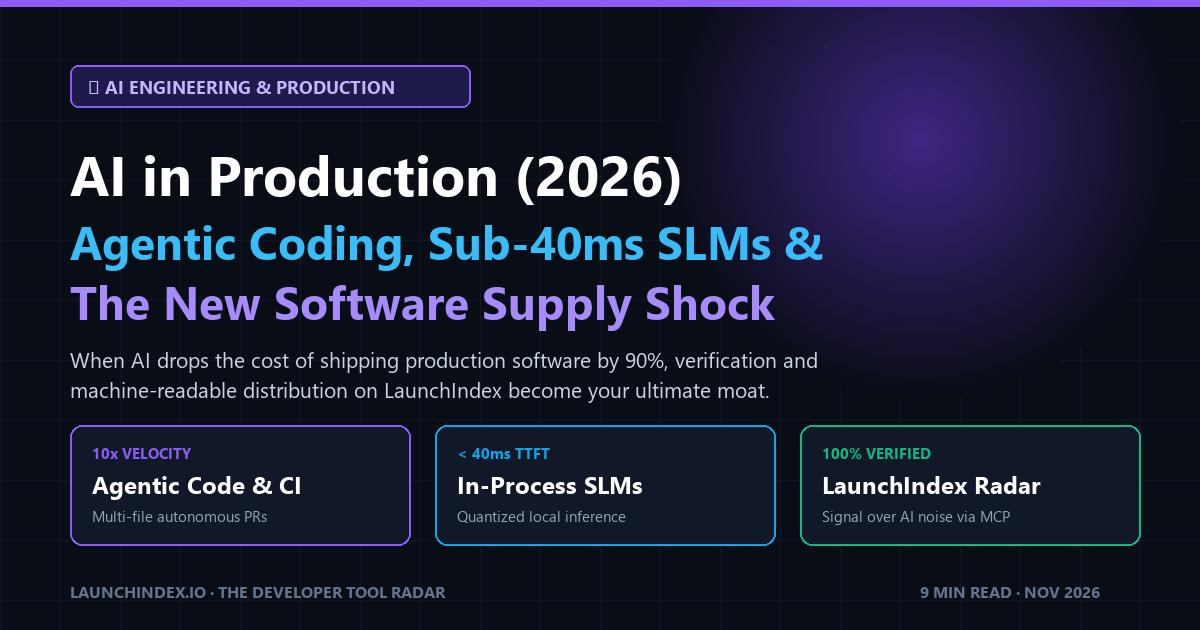
Beyond the Wrapper Era: AI Inside the Production Loop
In 2023 and 2024, "AI in software" meant two things: a single-line tab-autocomplete plugin inside VS Code, or a fragile SaaS wrapper making uncached, 4-second HTTP calls to a frontier model API and praying the response returned valid JSON.
In late 2026, that prototype era is dead.
Artificial Intelligence has fundamentally re-engineered software production across two distinct axes:
- How Software Is Built & Shipped (Build-Time Production): Multi-file autonomous coding agents now execute entire feature lifecycles—from database migration and API implementation to browser verification and Cloud Run deployment.
- How Software Operates at Scale (Runtime Production): Brittle, high-latency cloud LLM calls have been replaced by deterministic structured outputs, semantic caching layers, and quantized Small Language Models (SLMs) running in-process with sub-40ms Time-To-First-Token (TTFT).
And this technological leap has triggered a massive secondary shockwave across the entire software industry: when the cost and time to ship production-grade software drops by 90%, how do developers and buyers separate real, battle-tested infrastructure from a tidal wave of AI-generated noise?
Here is an engineering teardown of how new AI technologies are reshaping production systems in 2026—and why LaunchIndex was built to serve as the verification and discovery backbone for this new reality.
Part 1: The Three New Pillars of AI in Production
1. Agentic Engineering & Autonomous CI/CD
The shift from Copilots (which suggest the next 5 tokens) to Autonomous Engineering Agents (such as Google Antigravity, Claude Code, and Cursor Background Agents) has compressed the software development lifecycle by an order of magnitude.
In a modern 2026 production workflow, an engineer no longer manually wires boilerplate across 14 files. Instead, the engineer defines the architectural specification and verification constraints, and the agent:
- Inspects the live database schema and existing service interfaces.
- Writes the backend route, data models, and frontend components.
- Spins up a headless browser or test runner to validate the build (
478/478 static pages generated). - Diagnoses runtime edge cases (such as container memory limits or CDN cache headers) and pushes the verified commit directly to the deployment pipeline.
| Engineering Phase | 2022 Traditional Squad (5 Devs) | 2026 Agentic Solo Founder |
|---|---|---|
| Schema + CRUD API | 2 – 3 days | 12 minutes |
| Frontend UI + Edge OG Cards | 3 – 4 days | 20 minutes |
| Integration Tests & Linting | 1 – 2 days | Automated in-loop |
| Root-Cause Debugging (503/CORS) | 4 – 8 hours across logs | < 3 minutes (Log + trace ingestion) |
| Total Concept-to-Production | 2 Weeks (1 Sprint) | Under 2 Hours |
2. Runtime Production: Sub-40ms SLMs & Deterministic Grammars
Early AI features in production failed for three reasons: unpredictable hallucinations, 3,000ms+ tail latencies, and runaway token bills. You cannot put a 3-second, non-deterministic text generator inside a critical user checkout or real-time developer workflow.
In 2026, production AI architectures rely on three breakthroughs:
- Fine-Tuned Small Language Models (SLMs): Models in the 3B to 8B parameter class (such as Qwen-3-8B, Llama-4-8B, and Gemma-3) quantized to FP8 or INT4 run directly on dedicated GPU/NPU nodes via vLLM or TensorRT-LLM. For specialized tasks—like SQL generation, log classification, or metadata extraction—an 8B model matches frontier accuracy at 1/25th the cost and < 40ms latency.
- Constrained Decoding (Strict JSON Schemas): Production inference engines now enforce Context-Free Grammars (CFGs) at the token-sampling level. If your schema expects an array of typed objects, the model is mathematically prevented from sampling a token that violates your TypeScript/Pydantic schema.
- Tiered Model Routing & Semantic Caching: Before hitting a frontier reasoning model (like Gemini 4 Carbon or Claude), production gateways hash the embedding vector of the incoming request against a sub-millisecond vector cache (Redis/Qdrant) and route 85% of routine traffic to fast local SLMs.
// Modern 2026 Production AI Gateway Pattern:
// 1. Semantic Cache -> 2. Fast Constrained SLM -> 3. Frontier Fallback
import { z } from "zod";

const ToolEnrichmentSchema = z.object({
  category_slug: z.enum([
    "ai-agents",
    "dev-productivity-cli",
    "self-hosted-cloud",
    "data-apis",
    "security-auth",
  ]),
  technical_summary: z.string().max(280),
  is_open_source: z.boolean(),
  deployment_modes: z.array(z.enum(["docker", "binary", "cloud", "wasm"])),
});

export async function classifyToolInProduction(rawReadme: string) {
  // Deterministic constrained decoding on fast low-latency model
  const response = await inferenceClient.generateStructured({
    model: "slm-router-8b-fp8",
    schema: ToolEnrichmentSchema,
    temperature: 0.0, // Zero temperature for production determinism
    timeoutMs: 450,   // Strict SLA budget
    prompt: "Extract verified technical telemetry from this repository: " + rawReadme,
  });

  return ToolEnrichmentSchema.parse(response);
}
3. Self-Healing Observability & Autonomous SREs
Production outages used to mean waking up at 3:00 AM to grep through thousands of lines of CloudWatch or Cloud Run logs.
Today, AI agents sit directly on top of OpenTelemetry streams and webhook alerts. When a production endpoint throws an unexpected 503 Service Unavailable or a third-party scraper hits a Cloudflare 403 Forbidden:
- The observability agent correlates the stack trace with the exact Git commit SHA.
- It reproduces the failure in an isolated sandboxed branch.
- It synthesizes the fix (e.g., adding a streaming HTTP GET fallback or switching an incompatible Edge isolate to native Node.js).
- It opens a verified Pull Request with full regression test coverage before the human engineer even finishes their morning coffee.
Part 2: The Great Production Paradox (The 10x Supply Shock)
Here is the strategic reality every founder, CTO, and indie maker must confront in 2026:
When AI reduces the cost of building production software by 90%, the volume of launched software explodes by 1,000%.
Five years ago, building a polished developer tool with a custom dashboard, authentication, documentation, and CLI took a team of three engineers four months. That high barrier to entry acted as a natural filter. If a product existed and looked polished, it was probably backed by a serious team.
Today, that filter is gone.
- Over 1,500 new software products, AI agents, and micro-SaaS tools are launched every single week across GitHub, Product Hunt, Hacker News, and X.
- Anyone can prompt an agent to generate a sleek dark-mode landing page in 15 minutes.
- Production is no longer the bottleneck. Signal, Verification, and Distribution are the bottleneck.
When senior engineers or AI procurement agents evaluate a new dependency today, they ask:
"Is this tool real, actively maintained production software—or is it an unmaintained weekend AI wrapper that will vanish in 60 days?"
Part 3: How This Directly Relates to LaunchIndex
We built LaunchIndex specifically to solve the AI Production Paradox—both in how our own platform operates in production and in how we help real software founders stand out from the noise.
1. LaunchIndex Practices AI-Native Production Daily
LaunchIndex is not a static, manually updated web directory from 2018. Our own backend infrastructure runs an automated daily production radar on Google Cloud Run and Neon Serverless Postgres:
- Autonomous Daily Ingestion (08:00 UTC): Every morning, our ingestion engine scans global launch feeds, resolves obfuscated redirect graphs, scrapes live GitHub repository telemetry (stars, commit velocity, license types), and enriches tool profiles automatically.
- Automated Maker Outreach: Our system resolves canonical founder contact endpoints and dispatches personalized claim invitations so makers can verify their technical stack immediately.
2. The "Verified Launch" Trust Seal Against AI Vaporware
In a world flooded with synthetic clones, verification is the ultimate currency. When a founder claims and verifies their product on LaunchIndex (/claim/[slug]):
- Domain & Maker Verification: Proves real human engineering ownership behind the domain.
- Permanent DoFollow Backlink Equity: Signals to Google, Bing, and LLM retrieval crawlers that this domain is a trusted, vetted software entity—not an ephemeral spam page.
- Live Telemetry Tracking: Displays real-time community upvotes, GitHub star growth, deployment options (Docker, Self-Hosted, Single Binary), and verified alternatives (
/compare/[slug]).
3. Feeding the AI Agents That Choose Production Stacks
The most profound shift in 2026 is that AI agents are now the primary buyers and recommenders of developer tools.
When an engineer using Cursor, Claude Code, or Perplexity asks:
"What is the best verified tool for [use case] launched this month?"
The AI agent does not browse flashy hero animations. It queries structured, machine-readable indices. Because LaunchIndex exposes every indexed tool via:
/llms.txt&/llms-full.txt: Markdown-native registries built for LLM context windows./api/mcp: Our native Model Context Protocol server allowing AI coding assistants to query our live tool database directly.- Rich
SoftwareApplicationJSON-LD Schema: Giving zero-click search engines exact pricing, category, and feature matrices.
Being indexed and verified on LaunchIndex means your product is injected directly into the decision-making loop of the AI agents building tomorrow's software.
Summary: How to Win in the AI Production Era
- Embrace Agentic Velocity: Use autonomous coding agents and deterministic SLMs to keep your team tiny, your iteration speed blistering, and your infrastructure costs near zero.
- Design for Production Reliability: Replace flaky, unconstrained LLM prompts with strict schema validation, semantic caching, and self-healing observability.
- Invest Heavily in Verification & Machine-Readable Distribution: Code is no longer a moat; verified distribution is. Make sure your tool is claimed, verified, and feeding clean structured telemetry to both human engineers and AI answer engines.
Ready to Put Your Tool on the Radar?
- Submit Your Developer Tool or SaaS to LaunchIndex — Get indexed in our human directory,
/llms.txtregistry, and/api/mcpagent endpoint. - Claim Your Existing Tool Profile — Unlock your Verified Launch badge and permanent DoFollow backlink equity.
- Explore Weekly Breakout Cohorts — Discover the highest-velocity developer tools shipping in production right now.