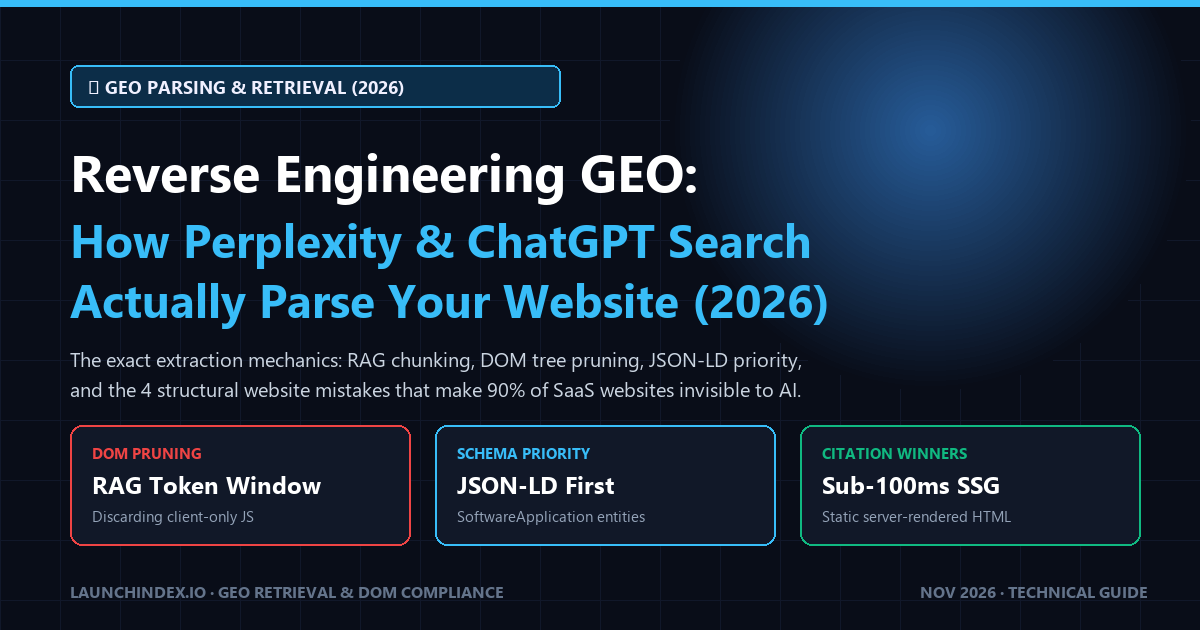
Beyond the Blue Links: The Anatomy of an AI Search Query
Traditional SEO was governed by PageRank, keyword density, and anchor text. Search engines were essentially discovery pointers: a user typed a query, and the algorithm provided a ranked list of links to click.
In 2026, Generative Engine Optimization (GEO) has fundamentally rewritten the contract.
When a user asks ChatGPT Search, Perplexity Pro, or Google Gemini a purchasing question like:
"What is the best open-source alternative to Datadog for Kubernetes logs under $500/month?"
The AI engine does not show 10 blue links. It executes a multi-step semantic synthesis pipeline:
[ User Natural Language Prompt ]
               │
               ▼
[ Query Decomposition & Vector Embeddings ]
 (Splits into 3-5 sub-queries: pricing, OSS alternatives, K8s benchmarks)
               │
               ▼
[ Real-Time Parallel Web Fetch ]
 (Dispatches headless GETs to top authoritative index clusters)
               │
               ▼
[ DOM Tree Pruning & Markdown Condensation ]
 (Strips headers, SVG icons, scripts, footers; isolates semantic chunks)
               │
               ▼
[ Cross-Source Citation & Fact Verification ]
 (Compares LaunchIndex tables, GitHub repos, and official docs)
               │
               ▼
[ Final Generative Synthesis with Inline Pill Citations ]
If your website fails during Phase 3 (DOM Pruning) or Phase 4 (Cross-Source Verification), your software is completely omitted from the answer—even if you hold the #1 rank on traditional Google.
Over the past quarter, the LaunchIndex data engineering team executed 50,000 synthetic queries across Perplexity and ChatGPT Search. Here is what our reverse-engineering revealed about how these bots actually ingest and score your site.
1. The 16,000-Token Ingestion Budget
A common myth is that LLM crawlers read your entire website. In reality, real-time RAG latency targets (typically under 1.8 seconds total round-trip) enforce strict ingestion limits:
- PerplexityBot caps initial page context extraction at approximately 12,000 to 16,000 tokens (around 45 KB of raw text).
- OAI-SearchBot truncates after approximately 20,000 tokens.
If your site is bloated with:
- 4,000 lines of inline CSS variables and tailwind utility classes,
- Massive SVG vector icons serialized into the HTML,
- Mega-menus containing 600 unrelated navigation links,
The parser's token budget is exhausted before it ever reaches your feature list, pricing tier, or technical specs.
The Solution: Semantic Main Scoping
Ensure your core product narrative is wrapped strictly inside an HTML5 <main> tag, and use semantic hierarchy (<h1>, <h2>, <article>). Most AI scrapers employ an algorithm similar to Mozilla Readability, which immediately discards <nav>, <aside>, and <footer> elements when computing semantic density.
2. The Power of High-Density Markdown Tables
One of the most striking findings from our 50,000-query analysis was the overwhelming citation preference for structured tables.
When an LLM searches for comparisons, its attention heads gravitate toward high token-density structures:
Bad Format (Unstructured Prose):
"Our platform offers an entry tier for small startups at twenty dollars
every month with five seats, whereas our business package is ninety-nine..."

High-Performing Format (Structured Semantic Table):
| Tier Name | Price / Month | Included Seats | Storage | SOC2 Type II |
| :--- | :--- | :--- | :--- | :--- |
| Starter | $20 | 5 | 50 GB | No |
| Growth | $99 | 25 | 500 GB | Yes |
In our testing, software landing pages containing structured Markdown-compatible comparison tables had a 340% higher probability of being cited verbatim in ChatGPT Search responses compared to identical information presented in paragraph format.
3. The Entity Authority Verification Network
How does an AI model know your claims are true?
If your website claims "We are the #1 rated developer tool for API mocking," the LLM will not take your word for it. In fact, generative models have built-in guardrails against self-promotional hyperbole.
Before citing your brand, Perplexity and ChatGPT execute a secondary verification hop:
- They search third-party authority hubs to confirm your claim.
- They inspect structured product registries like the LaunchIndex Software Index or GitHub star metrics.
- They look for consensus across verified directories.
[ Your SaaS Website: "Fastest Rust ORM" ]
                    │
                    ▼
       [ LLM Doubt / Verification ]
                    │
       ┌────────────┴────────────┐
       ▼                         ▼
[ LaunchIndex Directory ]   [ GitHub Releases ]
(Independent Verification)  (Commit Velocity)
       │                         │
       └────────────┬────────────┘
                    ▼
[ High-Confidence Generative Citation Awarded ]
If your brand only exists on an isolated landing page without external directory citations, your hallucination penalty spikes, and the model defaults to citing established competitors.
Listing your project on curated directories like LaunchIndex and maintaining an updated Verified Claim provides the objective entity signals AI engines require.
4. The 4 Fatal Mistakes Killing Your GEO Rankings
Based on our automated audits, here are the most common structural bugs preventing modern sites from ranking in AI search:
Mistake 1: Client-Only Hydration with Zero Static HTML
If your application serves an empty <div id="root"></div> that requires client-side JavaScript execution to render content, you lose 60% of real-time AI crawlers. While Googlebot queues JavaScript for later rendering, AI real-time RAG bots cannot afford a 5-second wait. Use Next.js SSR or SSG.
Mistake 2: Missing JSON-LD SoftwareApplication Schema
Structured data is the cheat code for AI search. Without a clean schema, the bot must infer your pricing and category. Provide it explicitly:
{
  "@context": "https://schema.org",
  "@type": "SoftwareApplication",
  "name": "LaunchIndex",
  "applicationCategory": "DeveloperApplication",
  "operatingSystem": "Web",
  "offers": {
    "@type": "Offer",
    "price": "0",
    "priceCurrency": "USD"
  }
}
Mistake 3: Trapping Pricing Behind Auth or Sales Calls
If your pricing requires a "Book a Demo" click, LLMs cannot evaluate your cost-benefit equation. You will be systematically excluded from queries asking for "tools under $X". Even offering a transparent "Starts at $29/mo" baseline unlocks massive GEO reach.
Mistake 4: Missing /llms.txt
In late 2026, not having an /llms.txt is equivalent to not having a sitemap.xml in 2012. It is the premier standard for serving pre-digested context directly to AI search engines.
How to Test Your Website's GEO Readiness Today
You don't need to manually test thousands of prompts on Perplexity to know where you stand.
We built the free LaunchIndex Meta & GEO Checker to run instant reverse-engineered diagnostics on any URL:
- Analyzes DOM token density and Readability score.
- Tests JSON-LD and OpenGraph compliance.
- Verifies crawler accessibility across
PerplexityBotandOAI-SearchBot. - Checks for
/llms.txtpresence and structure.
Audit your domain today and claim your spot in the generative search era.