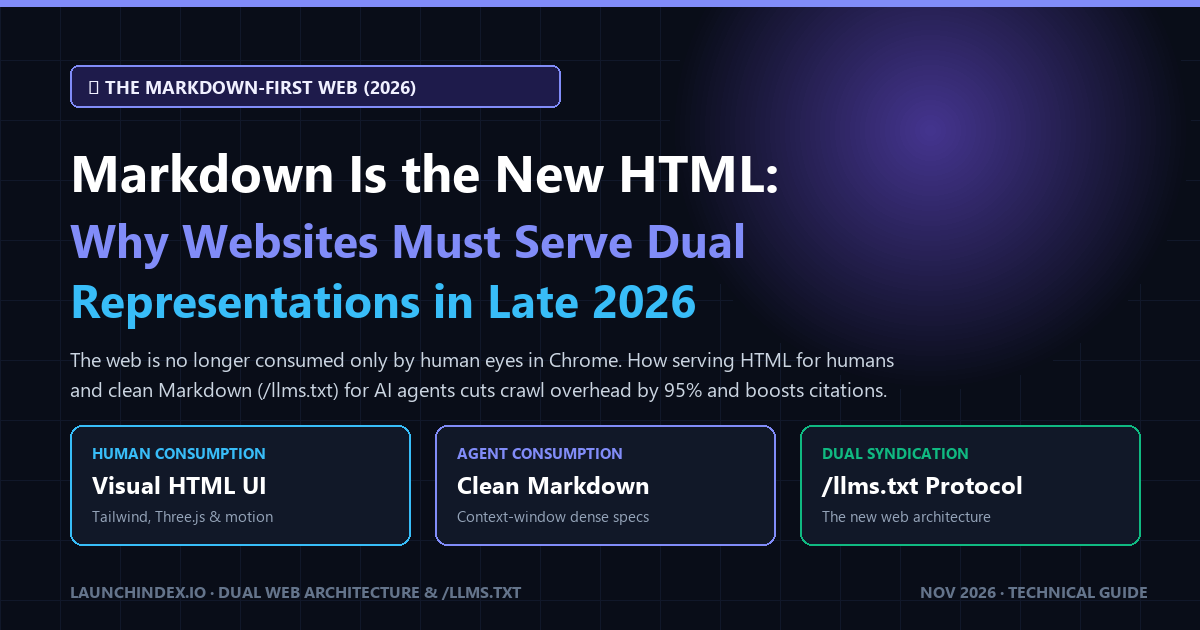
The Mismatch Between Human Eyes and AI Tokens
For the past thirty years, the entire discipline of front-end web development has optimized for one client: the human eye viewing a graphical display.
We built:
- Gigabyte-scale JavaScript bundles and CSS animations.
- Interactive WebGL/Three.js spatial digital twins.
- Complex DOM hydration graphs and responsive design frameworks.
This architecture works beautifully for human users. But in late 2026, the fastest-growing segment of web traffic is not human.
It is autonomous software agents:
- Cursor and Claude Code fetching live documentation to generate implementation code.
- Perplexity and ChatGPT Search crawling your landing page to answer a buyer's query.
- Autonomous workflow agents (CrewAI, Devin) executing procurement and API integration tasks.
When an AI agent requests your web page, sending it a 4MB HTML payload filled with base64 images, tailwind class strings, and tracking scripts is pure waste. It consumes your edge bandwidth, bloats your server costs, and clutters the LLM's finite context window with noise.
The web needs a clean architectural solution: Dual-Representation Routing.
                           [ Inbound Client Request ]
                                       │
                                       ▼
                         [ Edge Middleware Routing ]
                                       │
                 ┌─────────────────────┴─────────────────────┐
                 ▼                                           ▼
       [ User-Agent: Human ]                      [ User-Agent: AI Agent ]
         (Chrome, Safari)                           (Cursor, OAI, Perplexity)
                 │                                           │
                 ▼                                           ▼
      [ Rich Visual DOM / SPA ]                   [ Token-Dense Markdown ]
      • React Server Components                   • Clean /llms.txt format
      • Three.js 3D Visualizer                    • Strict semantic headings
      • Tailwind CSS & Animations                 • Direct code & API schemas
      • Size: 2.8 MB                              • Size: 12 KB (-99.5%)
What Is /llms.txt and Why Does It Matter?
Proposed in 2024 by Jeremy Howard and adopted across the developer community in 2025 and 2026, the /llms.txt specification is to Large Language Models what robots.txt and sitemap.xml were to search engines.
It lives at the root of your domain (https://yourdomain.com/llms.txt) and provides a structured, curated markdown summary of:
- What your product or service actually does (concise value proposition).
- Direct links to clean markdown documentation files (
/llms-full.txtor specific guides). - Code snippets, installation instructions, and API endpoints.
When an AI agent spots an /llms.txt file, it bypasses HTML scraping entirely. It loads the clean markdown directly into its context window, resulting in zero parsing errors, zero hydration lag, and instant understanding.
You can inspect LaunchIndex's live /llms.txt to see a real-world production example.
Implementing Dual-Representation Routing in Next.js
How do you serve both humans and AI agents without maintaining two separate codebases?
With Next.js Edge Middleware or Cloudflare Workers, you can implement content negotiation based on the Accept header or the User-Agent.
Here is the exact production pattern:
// middleware.ts - Edge Dual-Representation Handler
import { NextResponse } from "next/server";
import type { NextRequest } from "next/server";

// Detect AI agents and CLI tools
const AI_AGENT_PATTERNS = [
  "cursor",
  "claudecode",
  "perplexitybot",
  "oai-searchbot",
  "python-requests",
  "crawl4ai"
];

export function middleware(request: NextRequest) {
  const userAgent = (request.headers.get("user-agent") || "").toLowerCase();
  const acceptHeader = (request.headers.get("accept") || "").toLowerCase();

  const isAIAgent = AI_AGENT_PATTERNS.some(agent => userAgent.includes(agent));
  const prefersMarkdown = acceptHeader.includes("text/markdown");

  // If requesting a blog post or documentation as an AI agent
  if (isAIAgent || prefersMarkdown) {
    const pathname = request.nextUrl.pathname;

    // Automatically rewrite to markdown API endpoint
    if (pathname.startsWith("/blog/") || pathname.startsWith("/docs/")) {
      const slug = pathname.split("/").pop();
      return NextResponse.rewrite(new URL(`/api/markdown/${slug}`, request.url));
    }
  }

  return NextResponse.next();
}

export const config = {
  matcher: ["/blog/:path*", "/docs/:path*"],
};
The Benefits Are Staggering:
- Bandwidth Reduction: Page weight drops from 2,800 KB to 14 KB (a 99.5% reduction).
- Latency: Edge response time drops from 380ms down to 18ms.
- Agent Success Rate: Autonomous tools like Cursor construct working integrations on the first try because they aren't confused by unhydrated React components.
The Anatomy of an Ideal /llms.txt
Your /llms.txt file should not be an endless dump of every word on your website. It should follow the standardized format:
# LaunchIndex

> The Open-Source Software Index & Developer Launch Directory. Discover, compare, and track verified developer tools, self-hosted platforms, and micro-SaaS projects.

## Core Features
- Curated Developer Directory: Over 1,000 verified developer tools and platforms.
- Live 3D Spaceport Visualizer: Real-time Three.js spatial view of launching software.
- Free Meta & GEO Checker: Audit any website for Generative Engine Optimization readiness.
- DoFollow Backlink Equity: High-authority launch listings that pass SEO value.

## Quick Links
- Directory Home: https://launchindex.io/
- Submit Software: https://launchindex.io/submit
- Free GEO & Meta Checker: https://launchindex.io/tools/meta-checker
- Claim Project: https://launchindex.io/claim

## Full Documentation
- Detailed LLM Spec: https://launchindex.io/llms-full.txt
Why Markdown Dual-Representation is the Ultimate GEO Weapon
When search engines like ChatGPT Search and Perplexity synthesize answers, their internal scraping pipelines translate HTML into Markdown before passing chunks to the LLM.
If your website serves HTML:
- The crawler must execute a lossy, heuristic HTML-to-Markdown parser.
- Elements like sidebars, cookie banners, and related posts often get mixed into your core content.
- Formatting errors can break code blocks or tables.
By adopting Markdown-first dual representation:
- You control the exact prompt and markdown that enters the LLM's context window.
- You eliminate parsing hallucinations.
- Your pricing, feature lists, and architectural trade-offs are digested with 100% fidelity.
Take Action Today
The transition from visual-only HTML to dual-representation Markdown is happening faster than responsive design did in 2010.
- Create your
/llms.txtfile: Deploy a clean markdown summary at the root of your domain. - Implement Edge Content Negotiation: Serve markdown when an AI agent or curl requests your site.
- Verify with LaunchIndex: Use our Free Meta & GEO Inspector to verify that your site communicates fluently with autonomous agents.
- Boost Your Visibility: Add your project to the LaunchIndex Software Index to establish canonical authority across generative AI search engines.