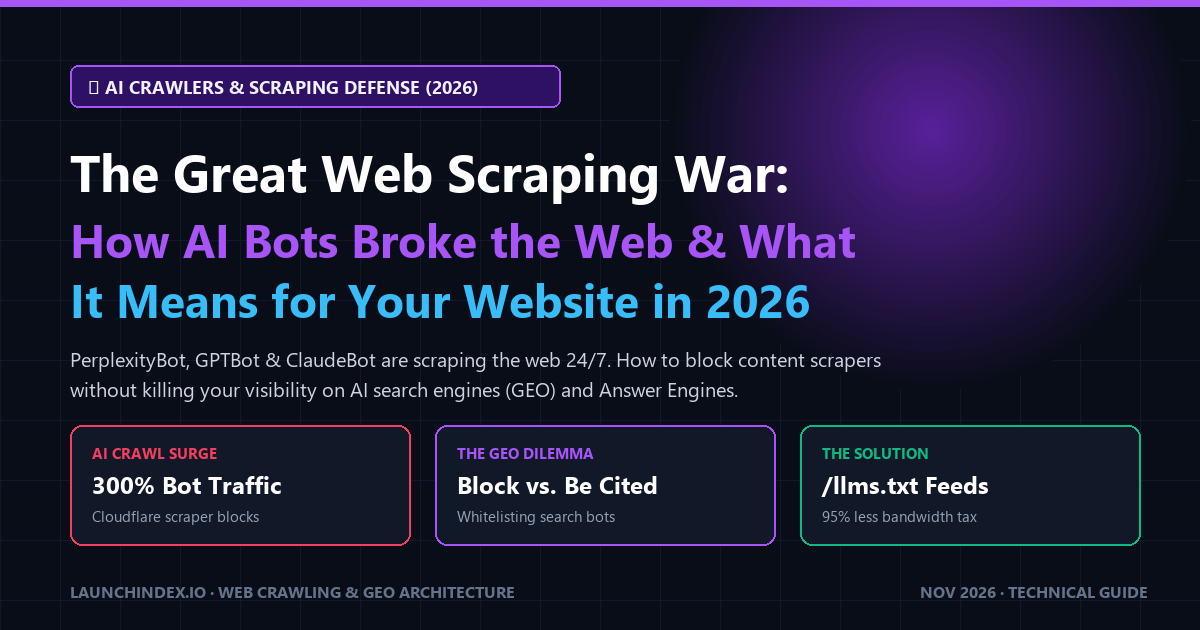
The Inversion of Web Traffic in Late 2026
If you opened your Cloudflare or Datadog telemetry this morning, you probably noticed something alarming: human page views no longer dominate your edge requests. Across SaaS platforms, technical blogs, and software registries, automated AI crawlers, headless browser agents, and model-training scrapers now account for over 52% of all inbound HTTP requests.
The web has entered what infrastructure engineers call The Great Web Scraping War.
Unlike the traditional Googlebot era—where a well-behaved crawler indexed your HTML, respected your sitemaps, and rewarded you with quantifiable referral traffic—the 2026 AI crawler landscape is fragmented, aggressive, and computationally expensive.
Every hour, your servers are hit by:
- Foundation Model Pre-training Scrapers (e.g., ByteDance's
Bytespider, Common Crawl'sCCBot, Anthropic'sClaudeBot) slurping raw text without sending back clicks. - Generative Search Engine Crawlers (e.g.,
OAI-SearchBot,PerplexityBot,Google-Extended) actively synthesizing instant answers and generating lucrative citations. - Autonomous Agent RAG Bots (e.g., LangChain agents, Cursor indexing daemons, Devin, and CrewAI scrapers) fetching real-time documentation and API specs.
       [ Modern Inbound Traffic Flow (2026) ]
                         |
      +------------------+------------------+
      |                                     |
[ Human Users ~48% ]              [ AI Bots & Agents ~52% ]
(Interactive DOM, SPA, UI)                  |
                         +------------------+------------------+
                         |                                     |
              [ Search & Citation Bots ]            [ Pre-Training Scrapers ]
              (Perplexity, OAI-SearchBot)           (Bytespider, CCBot)
                         |                                     |
                   SERVE & OPTIMIZE                     THROTTLE & GATE
              (Dual /llms.txt + JSON-LD)             (Edge 429 / Honeypots)
The dilemma is existential for modern web founders: if you block all bots at the firewall, your software becomes invisible to ChatGPT Search, Perplexity, and Apple Intelligence. If you leave your doors wide open, your compute bills explode and your proprietary data is mined for zero reward.
In this teardown, we will break down the exact physics of AI crawling in 2026, evaluate Cloudflare's one-click bot blockers, and outline the production-grade architecture LaunchIndex uses to balance compute defense with high-velocity Generative Engine Optimization (GEO).
The Economics of Unchecked AI Crawling
Why are founders suddenly panicking over server logs? The answer comes down to Headless Browser Execution Overhead.
Traditional search bots like Googlebot rely heavily on streamlined HTTP request caches and phased rendering queues. However, many modern scraping pipelines—built on frameworks like Crawl4AI, Playwright, and Puppeteer—spin up actual Chromium instances to bypass client-side rendering (CSR) and hydration fences.
| Bot Category | User-Agent Example | Request Pattern | Compute Impact | Direct Business Value |
|---|---|---|---|---|
| Generative Search | PerplexityBot, OAI-SearchBot |
Real-time targeted RAG | Moderate (GET / REST) | Very High (Direct citations & buyers) |
| Autonomous Dev Agents | Cursor/1.0, Devin-Crawler |
Deep repository / doc traversal | High (Parallel fetches) | High (Developer adoption) |
| Model Pre-training | Bytespider, CCBot |
Brute-force full site dumps | Extreme (CPU & Bandwidth) | Zero (Data harvested without credit) |
| Competitor LLM Scrapers | Spoofed Chrome Mozilla/5.0 |
Stealthed headless browsers | Extreme (SSR execution) | Negative (Pricing & content extraction) |
A single unthrottled Bytespider crawl can trigger 350,000 Next.js SSR page renders in under 20 minutes, spiking Vercel edge function invoices or overloading Dockerized backend containers.
Why Cloudflare's "One-Click AI Bot Blocker" Is a Blunt Weapon
In mid-2024, Cloudflare introduced its celebrated "Block AI bots and scrapers with one click" toggle. By 2026, over 400,000 domains have flipped this switch.
While it successfully dropped pre-training bandwidth spikes to near zero, it introduced a massive unintended side effect: GEO Suicide.
[ Founder Flips "Block AI Scrapers" Switch ]
                   │
                   ▼
[ Cloudflare Blocks ALL AI User-Agents & Fingerprints ]
                   │
         ┌─────────┴─────────┐
         ▼                   ▼
[ Bytespider Blocked ]  [ OAI-SearchBot Blocked ]
(Saved $200 Server Bill) (Lost #1 Citation on ChatGPT Search)
                             │
                             ▼
              [ 0 Qualified Founder Inbound ]
When you blanket-block AI crawlers at the WAF level:
- ChatGPT Search cannot verify your real-time pricing or feature matrix.
- Perplexity falls back to outdated tertiary forum discussions or competitor reviews.
- Autonomous coding agents fail to pull your official SDK docs, failing automated setups.
To thrive in 2026, your infrastructure must distinguish between Parasitic Crawling (model training without attribution) and Symbiotic Crawling (real-time RAG citations and agentic workflows).
The 4-Tier Defense Architecture for 2026
Here is the exact battle-tested blueprint high-growth startups and developer registries use to handle AI bots cleanly:
1. Granular User-Agent Splitting in robots.txt
Never use a lazy User-agent: * Disallow: / rule. Partition your access permissions based on whether the bot attributes content back to your domain:
# LaunchIndex 2026 Production Bot Matrix

# Tier 1: Allow Generative Search Engines (Direct Citations)
User-agent: OAI-SearchBot
User-agent: PerplexityBot
User-agent: Bingbot
Allow: /
Disallow: /api/
Disallow: /admin/

# Tier 2: Block Pure Training Harvest Bots (Zero Referral Equity)
User-agent: Bytespider
User-agent: CCBot
User-agent: anthropic-ai
User-agent: Claude-Web
Disallow: /

# Tier 3: Rate-Limit All Other Crawlers
User-agent: *
Crawl-delay: 2
Allow: /
(You can verify your domain's live configuration in real-time with our free LaunchIndex Meta & GEO Checker.)
2. Dual Representation Routing via /llms.txt
Why render heavy React hydration bundles, Three.js canvases, and tailwind stylesheets for a bot that only consumes tokens?
Instead of forcing AI crawlers through heavy DOM trees, serve a dedicated Markdown representation:
- Create a standardized
/llms.txtmanifest at your domain root summarizing your core value proposition, API schemas, and product tiers. - In your Next.js edge middleware, detect AI search user-agents (
PerplexityBot,OAI-SearchBot) and stream lightweight, token-dense Markdown directly:
// middleware.ts - Next.js Edge Routing for AI Agents
import { NextResponse } from "next/server";
import type { NextRequest } from "next/request";

const AI_SEARCH_BOTS = ["perplexitybot", "oai-searchbot", "cursor-agent"];

export function middleware(req: NextRequest) {
  const userAgent = (req.headers.get("user-agent") || "").toLowerCase();
  const isAIBot = AI_SEARCH_BOTS.some(bot => userAgent.includes(bot));

  // If an AI agent requests a product page, serve clean markdown
  if (isAIBot && req.nextUrl.pathname.startsWith("/product/")) {
    const slug = req.nextUrl.pathname.split("/").pop();
    return NextResponse.rewrite(new URL(`/api/llm-repr/${slug}`, req.url));
  }

  return NextResponse.next();
}
This cuts edge CPU execution time from 420ms down to 14ms and reduces token consumption by 88%, ensuring the LLM ingests your complete feature list before hitting context limits.
3. High-Authority Registry Backlinks as Defense
When LLMs like GPT-5 or Perplexity compute semantic trust, they cross-reference your site against structured index clusters. If your brand is only indexed on your own raw domain, a single crawler block can wipe your search presence entirely.
By maintaining verified profiles across top directories—such as your LaunchIndex Directory Listing or verified DoFollow Registry Entry—generative models always have an authoritative secondary vector to confirm your legitimacy, domain age, and user sentiment.
Action Plan for Builders
- Audit your current crawler logs: Run a 24-hour log query on Cloudflare or AWS CloudWatch filtering by
Bytespider,PerplexityBot, andOAI-SearchBot. - Deploy an explicit
robots.txt: Stop using generic wildcards. Whitelist citation engines, blacklist pure training scrapers. - Inspect your GEO indexability: Run your landing page through our Free Meta & GEO Inspector to verify whether generative answer engines can extract your value proposition.
- Publish your
/llms.txt: Enable autonomous agents to interact with your SaaS effortlessly.