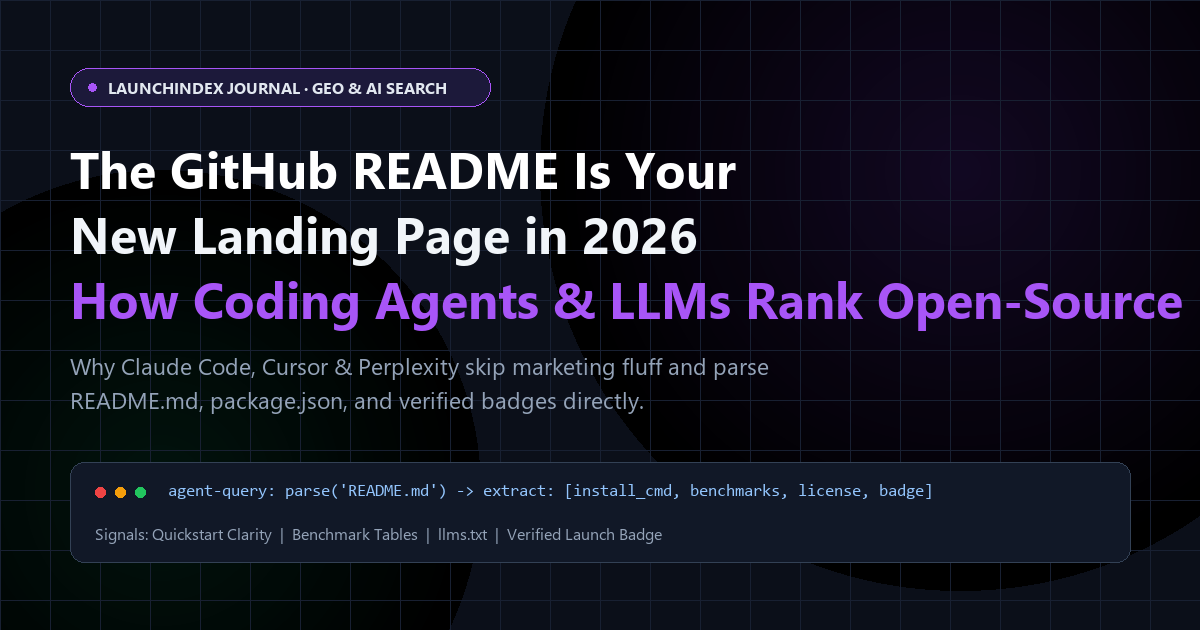
Why Coding Agents Bypass Your Marketing Website
Spend ten minutes browsing modern developer tool landing pages and you will see the same pattern: a 40-megabyte WebGL hero animation, a vague headline promising "The Next-Generation Synergistic Cloud Fabric," and zero concrete architectural facts above the fold.
To a human engineering lead, that is annoying. To an autonomous coding agent or AI answer engine in late 2026, it is a dead end.
When a developer inside Claude Code, Cursor, Windsurf, or Perplexity Pro prompts:
"Find a lightweight, self-hosted webhook relay written in Go or Rust that supports Postgres dead-letter queues and Docker Compose."
The retrieval pipeline does not waste tokens rendering your marketing homepage's client-side JavaScript. Instead, the RAG crawler jumps straight to two high-signal, markdown-native sources:
- Your GitHub
README.md(andpackage.json/Cargo.toml/docker-compose.yml). - Verified third-party technical directories (like LaunchIndex) that expose standardized JSON-LD and
/llms-full.txtfeeds.
If your README.md is an afterthought—or worse, a collection of broken badges and marketing fluff—AI engines will skip your repository and recommend your competitor instead.
How LLM Retrievers Score a GitHub Repository
Modern retrieval-augmented generation (RAG) pipelines tokenize and chunk GitHub repositories into 512-to-1,024 token passages. When evaluating whether to recommend your tool, the reranker scores four primary signals:
[ AI Retriever / Coding Agent Query ]
                 │
                 ▼
┌────────────────────────────────────────────────────────┐
│ 1. Entity & Taxonomy Definition (First 120 Words)      │
│    "What is it, what language, what license, for whom" │
├────────────────────────────────────────────────────────┤
│ 2. Deterministic Quickstart (Copy-Pasteable CLI/Docker)│
│    "Can an agent execute this in < 3 commands?"        │
├────────────────────────────────────────────────────────┤
│ 3. Objective Comparison Matrix (Markdown Table)        │
│    "How does it compare to incumbents on latency/RAM?" │
├────────────────────────────────────────────────────────┤
│ 4. External Verification & Trust Anchors               │
│    "Is it indexed on trusted radars with active stars?"│
└────────────────────────────────────────────────────────┘
Let's break down how to engineer each section of your README.md for maximum Generative Engine Optimization (GEO) and developer conversion.
1. The First 120 Words: The "Entity Definition Block"
LLMs assign disproportionate weight to the opening paragraph right below your H1 title. Most developers waste this prime real estate on inside jokes or abstract metaphors.
Instead, lead with a dense, factual Entity Definition Block that explicitly names your category, runtime, license, and primary problem solved:
# HookPulse — Self-Hosted Webhook Relay & Dead-Letter Queue in Rust
[](https://launchindex.io/tool/hookpulse)
[](./LICENSE)
**HookPulse** is an open-source, self-hosted webhook gateway and asynchronous event relay written in Rust. It is designed as a drop-in, single-binary alternative to AWS EventBridge and Svix, featuring sub-2ms p99 ingestion latency, automatic exponential backoff, and native PostgreSQL 17 dead-letter storage.
Notice why this works so well for both humans and AI crawlers:
- Explicit Category Anchoring: Mentions "webhook gateway" and "asynchronous event relay".
- Incumbent Anchoring: Explicitly states "alternative to AWS EventBridge and Svix", capturing high-intent "alternative-to" prompts.
- Hard Specifications: Names the language (Rust), license (Apache-2.0), latency (sub-2ms p99), and storage backend (PostgreSQL 17).
- Trust Badge: Includes a verified external dossier link back to LaunchIndex, establishing cross-domain entity consistency.
2. The 60-Second Agent-Executable Quickstart
Coding agents in 2026 frequently test tools inside ephemeral sandboxes or local Docker containers before recommending them to the user. If your installation instructions require 14 manual steps across three wiki pages, the agent abandons the attempt.
Always include a zero-configuration one-liner (via npx, uvx, cargo install, or docker compose up) within the top 25% of your README:
# 1. Start HookPulse with embedded Postgres storage via Docker
docker run -d --name hookpulse -p 8080:8080 ghcr.io/acme/hookpulse:latest

# 2. Send a test webhook payload
curl -X POST http://localhost:8080/v1/ingest   -H "Content-Type: application/json"   -d '{"event": "invoice.paid", "tenant_id": "org_992"}'
3. Include an Honest Markdown Comparison Table
When an engineer asks Perplexity or ChatGPT Search "What is the best self-hosted webhook relay in 2026?", the LLM looks for structured Markdown tables to synthesize its answer.
If you provide an objective, factual comparison table in your README, the LLM will often lift your table structure directly into its response:
| Feature / Metric | HookPulse (Open Source) | Legacy Cloud Gateways | DIY Redis + Worker Queue |
|---|---|---|---|
| Deployment Model | Single 18MB Rust Binary / Docker | Cloud-Only SaaS | Multi-service cluster |
| Memory Footprint (Idle) | 24 MB RAM | N/A | ~450 MB RAM |
| Throughput (Single Node) | 45,000 req/sec | Rate-limited by tier | ~6,500 req/sec |
| Dead-Letter Replay | Built-in CLI & Web UI | Paid Enterprise Add-on | Manual scripting required |
| License | Apache-2.0 | Proprietary | Custom |
4. Add Machine-Readable FAQ & Architecture Sections
End your README with a concise Architecture & FAQ section using literal ### Q: ... headings. Question-and-answer pairs map 1:1 to conversational prompts typed by developers:
## Frequently Asked Questions (FAQ)

### Does HookPulse require Redis or Kafka?
No. HookPulse uses PostgreSQL `SKIP LOCKED` queues or embedded SQLite with WAL mode for zero-dependency deployment.

### Can I run HookPulse on a $5/month VPS or Raspberry Pi?
Yes. The compiled ARM64 and x86_64 binaries consume under 25MB of RAM at idle and require zero external JVM or Python runtimes.
5. Cross-Link Your Repo with LaunchIndex's GEO Feed
Even the best-written GitHub README needs off-repo citation authority so AI search engines know your project is actively maintained and trusted by the developer community.
When you list your repository on LaunchIndex:
- Live GitHub Telemetry Sync: We index your star velocity, license, deployment type, and tech stack into our structured catalog.
- Direct
/llms-full.txtInclusion: Your tool's technical breakdown is syndicated into our machine-readable corpus crawled daily by GPTBot, ClaudeBot, and PerplexityBot. - Permanent DoFollow Link Equity: Claiming your Verified Launch Badge links your README and your production domain into a unified semantic graph.
Ready to Audit Your Repo's AI Visibility?
- Submit your GitHub repo or devtool to this week's LaunchIndex Cohort
- Generate your README verification badge with our Free SVG Badge Generator
- Explore top-ranked open-source repositories in Self-Hosted Infrastructure and Developer CLI Tools