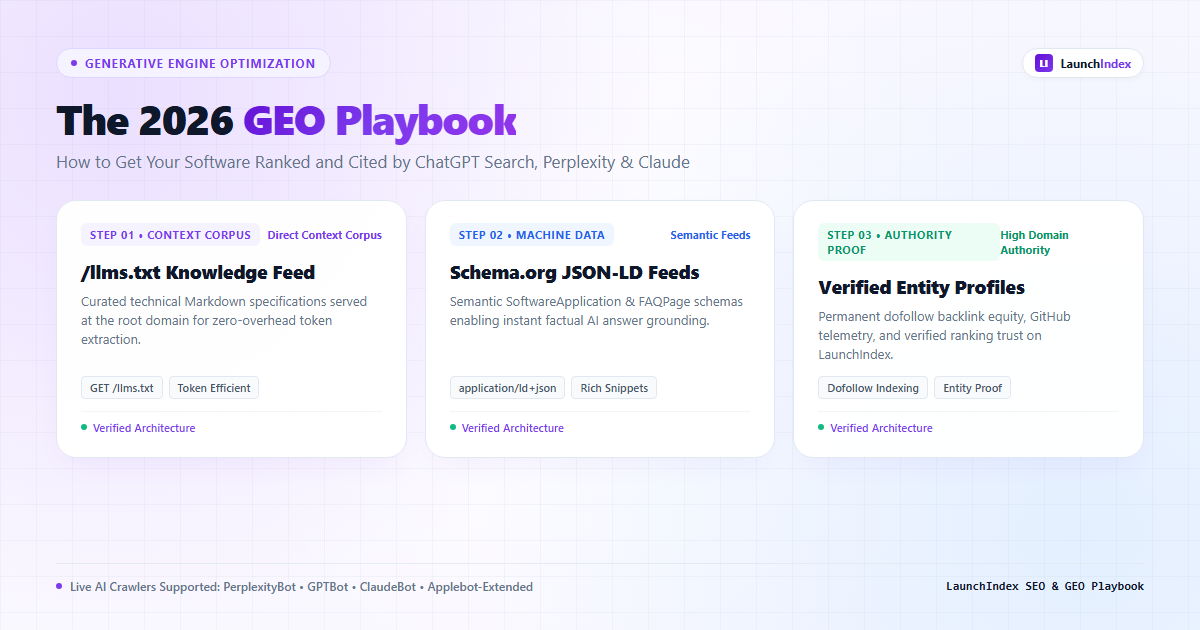
The Trend: AI Agents Are Now Auditing Your AI Visibility
Two shifts are colliding this week in developer circles:
- Model Context Protocol (MCP) is everywhere. Coding agents like Claude Code and Cursor now call external tool servers the way browsers call APIs.
- Generative Engine Optimization (GEO) went from buzzword to budget line. Teams want to know when ChatGPT, Perplexity, Claude and Google AI Overviews cite their product, and when they do not.
The result is a new category: GEO MCP servers, where an agent in your editor runs AI-visibility audits for you instead of you refreshing a dashboard.
What Is a GEO MCP Server?
An MCP server exposes a small set of typed tools over a standard protocol. A GEO-focused one typically offers:
- Citation lookup: which sources an AI engine cites for a given prompt
- Share-of-voice: how often your brand appears next to competitors
- Prompt testing: run "best tool for X" prompts and record the answer
- Content gap analysis: which questions your docs do not answer yet
Because the agent is already in your repo, it can go from finding a gap to editing the page in one session.
Why This Matters for Discoverability
AI answer engines pick sources they can parse cleanly. In practice that favours:
| Signal | Why AI engines care | What to do |
|---|---|---|
| /llms.txt | A curated, markdown-first map of your site | Publish it at the root and keep it current |
| Structured data (JSON-LD) | Unambiguous facts: name, category, pricing | Add SoftwareApplication and FAQPage schema |
| Server-side rendering | Crawlers often skip heavy client-side JS | Render key content in the initial HTML |
| Clear, quotable answers | Engines lift short, self-contained passages | Lead each section with a one-sentence answer |
| Third-party mentions | Citations cluster around trusted directories | Get listed with dofollow, high-authority sources |
A 30-Minute GEO Audit You Can Run Today
Step 1: Ask the engines directly
Write 10 prompts a real buyer would type, such as "best open-source alternative to X". Run them in ChatGPT, Perplexity and Claude. Record whether you are named, and which sources are cited.
Step 2: Check your machine-readable surface
curl -s https://yourdomain.com/llms.txt | head -20
curl -s https://yourdomain.com | grep -c "application/ld+json"
If the first command returns a 404 or the second returns 0, that is your first fix.
Step 3: Fix the answer, not just the keywords
For each missed prompt, add a short section that answers it in two or three sentences, then support it with a comparison table or FAQ.
Step 4: Earn the citations
Engines cite sources that other sources already cite. Submit to quality directories and keep your listing facts consistent everywhere.
A Security Note Before You Wire Up Any MCP Server
MCP servers and editor extensions run with real access to your files and credentials. Hacker News front-page discussion this week included a reported backdoor in an extension for a coding agent distributed through an editor marketplace. Treat every MCP server like a dependency:
- Prefer servers from vendors you can identify, with a public repository
- Pin versions and review what tools and permissions a server requests
- Give agents read-only credentials wherever possible
- Never paste production secrets into an agent session
Where LaunchIndex Fits
LaunchIndex publishes the same machine-readable surface we recommend above:
- /llms.txt and /llms-full.txt for AI crawlers
- A Schema.org SoftwareApplication feed at /api/geo/feed.json
- An MCP endpoint at /api/mcp so agents can query the catalogue directly
If you build a developer tool, submit it to LaunchIndex to get a structured, crawlable profile with a verified badge, and use our free submission checklist to find the other directories worth your time.
Key Takeaways
- GEO MCP servers let agents audit AI visibility from inside your editor.
- Machine-readable structure (llms.txt, JSON-LD, SSR) is the foundation.
- Quotable answers and third-party citations decide who gets named.
- Vet every MCP server like any other dependency.