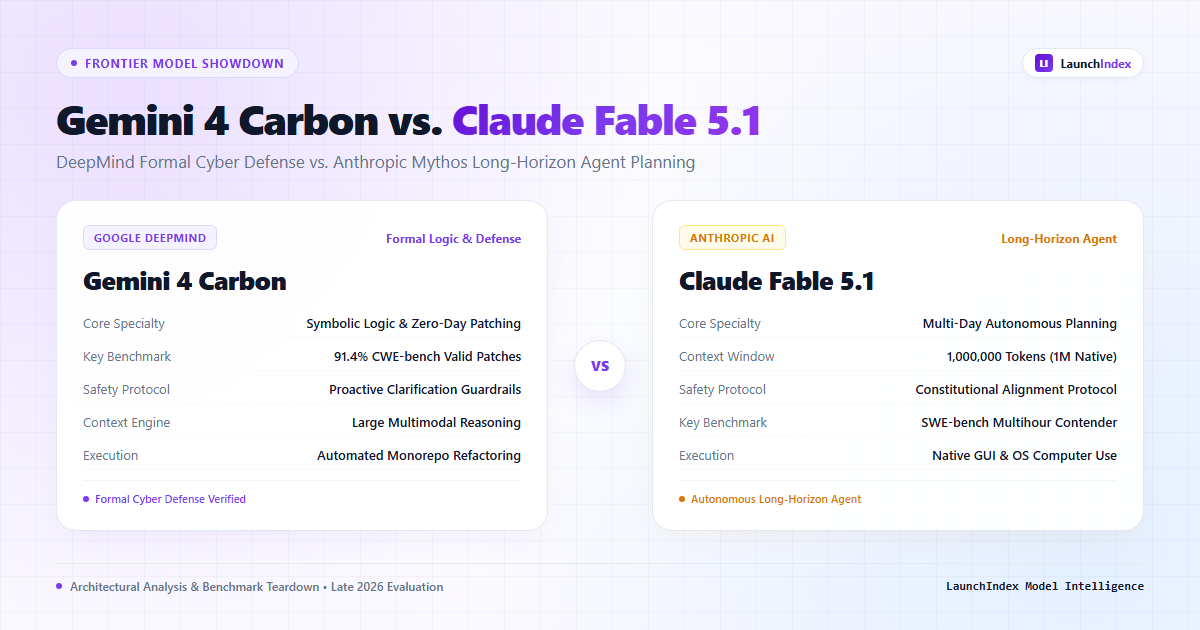
The Battle for the Next Decade of Autonomous Computing
The frontier AI landscape in late 2026 has crystallized into a high-stakes duel between two philosophical titans: Google DeepMind and Anthropic.
Both labs have unleashed their premier model tiers designed for autonomous knowledge work, deep reasoning, and complex coding:
- Gemini 4 Carbon from Google DeepMind
- Claude Fable 5.1 from Anthropic (derived from their Mythos-class frontier research)
While consumer chatbots grab headlines, enterprise engineering teams and startup founders are asking the pragmatic question: Which model actually powers better developer tools, autonomous coding workflows, and reliable agents?
Here is the comprehensive head-to-head architectural teardown.
1. Architectural Philosophy: How They Differ
Gemini 4 Carbon: The Rigorous Systems Engineer
Google DeepMind designed Carbon with an emphasis on precision, symbolic verification, and adversarial resilience. Carbon behaves like a senior principal systems architect:
- Excels in finding zero-day vulnerabilities, buffer overflows, and security flaws.
- Refuses to guess on underspecified instructions; will proactively pause and ask for technical clarifications.
- Integrated deeply with Google's TPU cluster infrastructure for low-latency code execution.
Claude Fable 5.1: The Autonomous Knowledge Orchestrator
Anthropic's Fable 5.1 (the generally available counterpart to their restricted Mythos 5.1 model) is engineered for long-horizon agentic autonomy:
- Built to handle multi-day, multi-stage projects without losing context.
- Boasts a native 1-million-token context window with near-perfect needle-in-a-haystack retrieval.
- Features state-of-the-art Computer Use capabilities, allowing it to navigate browser environments, execute bash scripts, and interact with desktop GUIs.
2. Direct Head-to-Head Comparison
| Capability | Gemini 4 Carbon (Google DeepMind) | Claude Fable 5.1 (Anthropic) | Winner |
|---|---|---|---|
| Core Specialization | Vulnerability patching, cyber defense, symbolic logic | Multi-step agentic planning, autonomous coding, writing | Tie (Context-dependent) |
| Context Window | Large multimodal context | 1,000,000 tokens (1M) | Claude Fable 5.1 |
| Cybersecurity & Safety | SEC-bench Pro SOTA, CWE-bench leader | Constitutional AI, robust alignment | Gemini 4 Carbon |
| Clarification Handling | Active interrogation (asks for clarity when ambiguous) | Presumes most probable intent | Gemini 4 Carbon |
| Tool & Computer Use | Function calling, API orchestration | Native Computer Use (Mouse, keyboard, browser automation) | Claude Fable 5.1 |
| Prose & Explanations | Concise, technical, minimal fluff | Fluid, nuanced, exceptional documentation tone | Claude Fable 5.1 |
3. Deep Dive: Coding & Agentic Workflows
Scenario A: Large-Scale Monorepo Refactoring
When asked to analyze a 200,000-line repository, trace broken dependencies, and replace deprecated ORM queries across 40 files:
- Claude Fable 5.1 shines due to its 1M token context window and persistent memory. It holds the entire project state in memory, maps dependencies with high fidelity, and generates harmonious refactoring PRs across the full project tree.
- Gemini 4 Carbon approaches the task through systematic divide-and-conquer logic, running rigorous syntax and type checks to ensure zero regressions, though it benefits from chunked retrieval.
Scenario B: Security Auditing & Automated Bug Patching
When fed a complex C++ or Rust network protocol implementation with an obscure memory safety flaw:
- Gemini 4 Carbon is arguably the most capable model ever released in this domain. It identifies the root-cause vulnerability, verifies the exploit vector, and produces a mathematically sound patch that does not degrade system throughput.
- Claude Fable 5.1 correctly flags standard vulnerability classes but lacks Carbon's specialized fine-tuning on formal verification and SEC-bench testbeds.
4. The Verdict: Which Model Should You Use?
Neither model strictly dominates the other; rather, they serve complementary poles of the modern engineering stack:
Choose Gemini 4 Carbon if:
- You are building security-critical systems, fintech infrastructure, or automated vulnerability scanners.
- You want an AI that strictly refuses to hallucinate and actively pushes back when requirements are ambiguous.
- You require deep integration with Google Cloud Platform, Iron TPUs, and Google's developer ecosystem.
Choose Claude Fable 5.1 if:
- You are building long-horizon autonomous agents that need to execute multi-step workflows over hours or days.
- You need native 1M token context to ingest full codebases, books, or financial datasets in a single prompt.
- Your workflows rely on Computer Use (controlling UI widgets, browsers, and terminal sessions).
Building with Next-Gen Models on LaunchIndex
As models like Gemini 4 Carbon and Claude Fable 5.1 take over software development, the way users discover your product changes fundamentally.
Both models rely heavily on machine-readable indexes like LaunchIndex's /llms.txt and structured JSON-LD feeds to cite software recommendations accurately.
Want to ensure your SaaS is recognized and cited by both Google and Anthropic models? Submit your tool to LaunchIndex today.