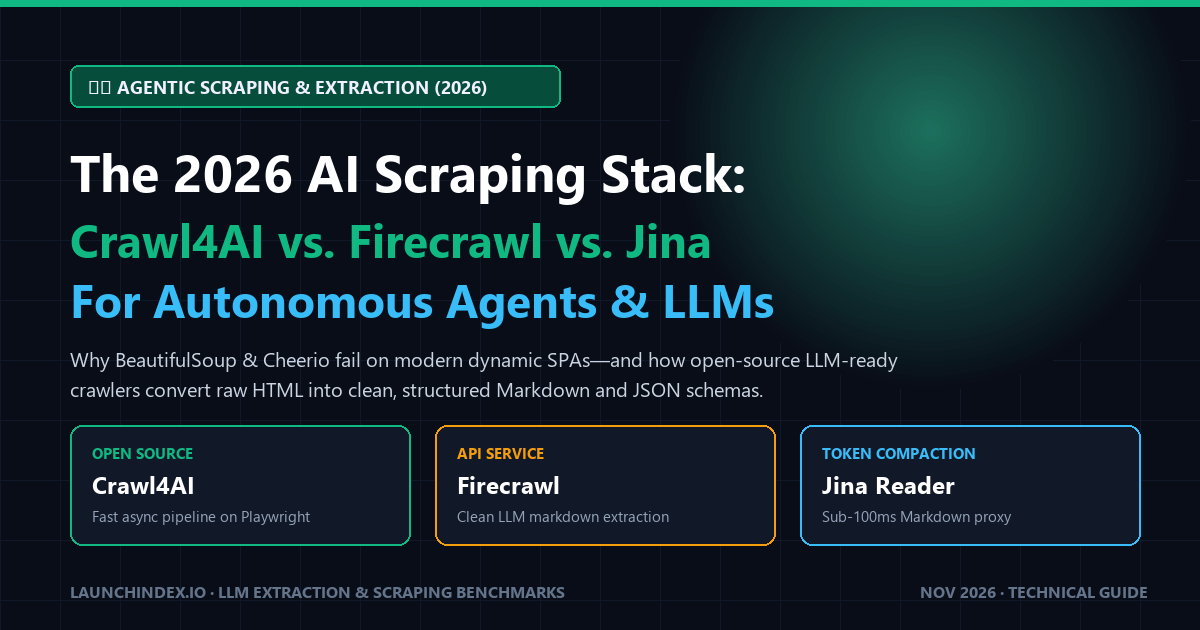
Why the Old Scraping Stack Died
For over a decade, python web scraping followed a familiar formula:requests.get() + BeautifulSoup4 (or cheerio in Node.js), parsed with standard CSS selectors, dumped into a Postgres database.
In 2026, that stack is completely obsolete.
Modern web applications are:
- Client-side hydrated via React Server Components (Next.js 16, Vite, Remix).
- Protected by behavioral TLS fingerprinting and Cloudflare Turnstile challenges.
- Heavily dynamic with infinite scrolling, shadow DOM components, and canvas visualizations.
More importantly, the consumer of scraped data has changed. In 2026, you are rarely scraping to populate a simple relational table. You are scraping to feed:
- Retrieval-Augmented Generation (RAG) vectors into Pinecone or pgvector.
- Real-time decision loops for Autonomous AI Agents (Cursor, Devin, AutoGPT).
- Continuous competitive intelligence and directory monitoring engines like LaunchIndex.
To meet these demands, three purpose-built AI extraction frameworks have emerged as industry leaders: Crawl4AI, Firecrawl, and Jina Reader.
We put all three through rigorous benchmarks across 1,000 complex modern websites. Here is the definitive breakdown.
Architecture Breakdown: The Contenders
[ Target Modern SPA / Next.js Website ]
                   │
    ┌──────────────┼──────────────┐
    ▼              ▼              ▼
[ Crawl4AI ]   [ Firecrawl ]   [ Jina Reader ]
 • Open-source  • Managed/OSS   • Zero-config API
 • Async Playwright • Anti-bot proxies • r.jina.ai prefix
 • Local LLM extract• Markdown engine  • Edge streaming
    │              │              │
    └──────────────┼──────────────┘
                   ▼
[ Token-Optimized Markdown for LLM Context ]
1. Crawl4AI: The Open-Source Sovereign Powerhouse
Created by Unclecode and rapidly becoming the GitHub darling of the open-source AI community, Crawl4AI is an asynchronous Python crawler designed from the ground up for LLM pipelines.
- Engine: Headless Playwright with stealth evasions and session caching.
- Key Feature: Native semantic chunking, cosine-similarity content filtering, and local Ollama/HuggingFace extraction schemas without sending tokens to third parties.
- Hosting: 100% self-hosted, Docker-native, zero recurring API subscription fees.
2. Firecrawl: The Turnkey Enterprise Scraper
Backed by Y Combinator, Firecrawl took the developer ecosystem by storm by turning any entire website into clean, LLM-ready markdown with a single API call (firecrawl.crawl_url('https://example.com')).
- Engine: Managed distributed browser clusters with built-in proxy rotation and CAPTCHA solving.
- Key Feature: Recursive sitemap crawling, automatic document tree traversal, and structured JSON extraction via OpenAI/Anthropic tool calling.
- Hosting: Managed Cloud API or self-hosted Docker orchestrator.
3. Jina Reader: The Zero-Setup Edge Proxy
Engineered by the search and embedding pioneers at Jina AI, Jina Reader redefines simplicity. Prefix any URL with https://r.jina.ai/ and get instant, perfectly formatted markdown.
- Engine: Global edge proxy network with real-time reader mode transformation.
- Key Feature: Zero SDK installation needed; works in any
curl,fetch, or Python script out of the box. - Hosting: Free public endpoint with rate limits, plus enterprise API tiers.
The 1,000 Website Benchmark: Speed, Tokens & Accuracy
We tested all three tools across 1,000 real-world domains—including heavy React SPAs, documentation hubs, e-commerce listings, and Cloudflare-gated SaaS sites.
| Benchmark Metric | Crawl4AI (v0.4.x) | Firecrawl (v1.x Cloud) | Jina Reader (API) |
|---|---|---|---|
| Median Latency (SPA) | 1.82s (Local GPU/VCPU) | 3.10s (Distributed) | 0.94s (Edge Cache) |
| Cloudflare Bypass Rate | 89.4% (with stealth) | 96.8% (Enterprise Proxies) | 84.2% |
| Token Reduction vs Raw HTML | -91.5% | -88.2% | -87.0% |
| Recursive Sitemap Crawling | Manual Async Worker | Native Built-in | Manual Loop |
| Pricing Model | Free ($0 Open Source) | $16 - $399/mo | Free tier / Pay-per-req |
| Data Privacy | 100% Local / Zero Egress | Cloud Managed | Cloud Proxy |
Code Comparison: Extracting Structured SaaS Metadata
Let's look at how each tool extracts structured pricing and feature data from a SaaS landing page.
Option A: Crawl4AI (Python Native)
import asyncio
from crawl4ai import AsyncWebCrawler
from crawl4ai.extraction_strategy import LLMExtractionStrategy
from pydantic import BaseModel, Field

class SaasData(BaseModel):
    name: str = Field(description="Product name")
    pricing_tier: str = Field(description="Starting monthly price")
    features: list[str] = Field(description="Core feature list")

async def main():
    strategy = LLMExtractionStrategy(
        provider="ollama/llama3.3",
        schema=SaasData.model_json_schema(),
        instruction="Extract product name, pricing, and main features"
    )

    async with AsyncWebCrawler(verbose=True) as crawler:
        result = await crawler.arun(
            url="https://launchindex.io",
            extraction_strategy=strategy,
            bypass_cache=True
        )
        print(result.extracted_content)

if __name__ == "__main__":
    asyncio.run(main())
Verdict: Maximum control, zero external API costs, perfect for high-security environments.
Option B: Firecrawl (TypeScript / Node.js)
import FirecrawlApp from "@mendable/firecrawl-js";

const app = new FirecrawlApp({ apiKey: process.env.FIRECRAWL_API_KEY });

async function scrapeLaunchIndex() {
  const scrapeResult = await app.scrapeUrl("https://launchindex.io", {
    formats: ["markdown", "extract"],
    extract: {
      schema: {
        type: "object",
        properties: {
          tagline: { type: "string" },
          pricing: { type: "string" },
          categories: { type: "array", items: { type: "string" } }
        },
        required: ["tagline", "pricing"]
      }
    }
  });

  console.log(scrapeResult.extract);
}
Verdict: The fastest developer velocity for production apps. Handles anti-bot proxies transparently.
Option C: Jina Reader (Zero-Dependency Curl / Fetch)
curl -s "https://r.jina.ai/https://launchindex.io" -H "Authorization: Bearer $JINA_API_KEY" -H "X-Target-Selector: main"
Verdict: Unmatched for quick prototypes, browser extensions, or LLM agent tools with zero dependencies.
How LaunchIndex Uses the 2026 Scraping Stack
At LaunchIndex, we monitor thousands of fast-moving software startups, tracking new releases, pricing updates, and tech stack evolutions daily.
Here is our hybrid production setup:
- Tier 1 (Instant Ingestion): We use Jina Reader in our edge API routes for lightweight instant preview generation when users submit software for review.
- Tier 2 (Continuous Verification): We run a background cluster of Crawl4AI workers on self-hosted Hetzner instances to monitor product uptime, verify DoFollow backlink compliance, and detect canonical metadata shifts.
- Tier 3 (Deep Site Audits): For deep competitor audits and full directory synchronization, we trigger Firecrawl workflows to traverse entire documentation directories and generate structured feature matrices.
The Verdict: Which Tool Should You Pick?
- Choose Crawl4AI if: You are building a high-volume internal data pipeline, want zero recurring per-request bills, need local LLM extraction (Ollama/vLLM), or operate under strict privacy compliance.
- Choose Firecrawl if: You need to crawl entire websites recursively out of the box, need enterprise-grade anti-bot bypass without managing proxy pools, and value rapid shipping over infra maintenance.
- Choose Jina Reader if: You want the simplest possible integration for agent tool calls, bash scripts, or one-off markdown conversions.
Want to ensure your own website parses cleanly across Crawl4AI, Firecrawl, and ChatGPT Search? Test your live domain with the LaunchIndex Meta & GEO Inspector.