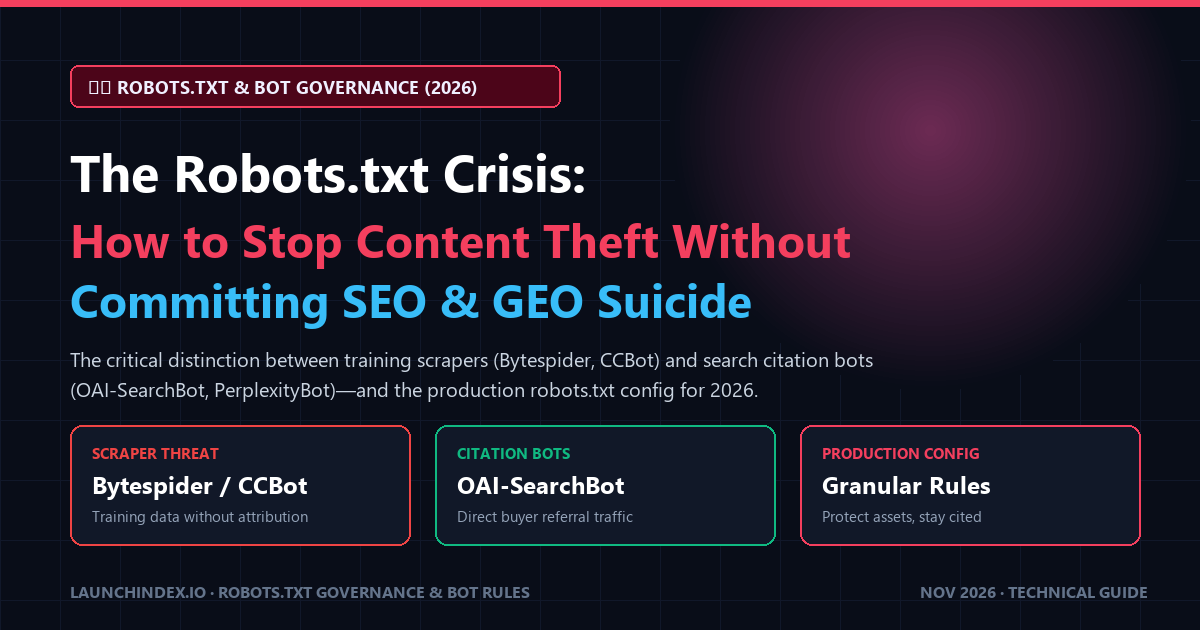
The 30-Year-Old File That Controls Your AI Future
Invented in 1994 by Martijn Koster, the humble robots.txt protocol was originally designed to stop early web crawlers from crashing fragile university web servers. For thirty years, it remained a simple, sleepy convention.
In 2026, it is the most contested text file on the internet.
Publishers, media conglomerates, and indie SaaS founders find themselves trapped between two competing fears:
- The Fear of Being Exploited: AI frontier labs scraping your proprietary documentation, code examples, and blog posts to train foundation models without payment or attribution.
- The Fear of Becoming Invisible: Blocking crawlers so aggressively that ChatGPT Search, Perplexity, and Apple Intelligence have no record of your product's existence.
The problem is compounded by widespread misinformation. Many tutorials recommend blanket disallow rules that accidentally wipe out 80% of a startup's organic inbound funnel.
Let's unpack the reality of the 2026 robots.txt crisis and look at the production template used by high-visibility tech brands.
The Great Bot Division: Training Scrapers vs. Search Crawlers
The fundamental mistake engineering teams make is treating all AI bots as a single entity. In reality, modern AI companies deploy two completely separate fleets of bots with different user-agents and distinct objectives:
[ OpenAI Bot Architecture ]
         │
         ├─────────────────────────────────────────┐
         ▼                                         ▼
   [ GPTBot ]                              [ OAI-SearchBot ]
   • Offline Pre-training                  • Real-Time Search & RAG
   • Ingests data for future models        • Generates citations in ChatGPT
   • Zero direct referral clicks           • Drives massive qualified traffic
   • SAFE TO BLOCK IF CONCERNED            • DO NOT BLOCK (GEO Suicide)
The same dichotomy exists across other major providers:
| Provider | Offline Model Training Bot (Safe to Block) | Real-Time Search / Citation Bot (Must Allow) |
|---|---|---|
| OpenAI | GPTBot |
OAI-SearchBot |
| Perplexity | (None - All real-time) | PerplexityBot |
Google-Extended (Gemini training) |
Googlebot (Search index) |
|
| Anthropic | ClaudeBot / anthropic-ai |
Claude-Web (User prompt fetches) |
| ByteDance | Bytespider (TikTok/AI training) |
(No search value) |
| Common Crawl | CCBot (Open pre-training corpus) |
(No search value) |
If your goal is to protect your server compute and intellectual property while maximizing your inbound customer discovery, you block the left column and aggressively welcome the right column.
The Fatal "Block-All" Mistake
Here is the exact robots.txt snippet that caused a 42% drop in qualified SaaS inbound for a popular developer tool earlier this year:
# DANGEROUS CONFIGURATION - DO NOT USE
User-agent: *
Disallow: /

User-agent: Googlebot
Allow: /
While the team assumed this would protect them from scrapers while keeping traditional Google intact, they didn't realize that ChatGPT Search and Perplexity respect User-agent: * unless explicitly overridden.
As a result:
- When enterprise software buyers asked ChatGPT: "Compare LaunchIndex alternatives for developer launch directories," their tool was completely absent from the answer.
- The model cited their competitors who maintained open, structured crawler policies.
The Battle-Tested 2026 Production robots.txt
Here is the exact production template recommended by LaunchIndex. It blocks aggressive training harvesters, protects private admin and API routes, and ensures complete visibility across all generative search engines:
# ===============================================================
# LaunchIndex Recommended robots.txt (2026 Standards)
# ===============================================================

# 1. Real-Time Generative Search Engines (HIGH PRIORITY CITATIONS)
User-agent: OAI-SearchBot
User-agent: PerplexityBot
User-agent: Claude-Web
Allow: /
Disallow: /api/
Disallow: /admin/
Disallow: /dashboard/

# 2. Traditional Search Engines
User-agent: Googlebot
User-agent: Bingbot
User-agent: DuckDuckBot
Allow: /
Disallow: /api/
Disallow: /admin/
Disallow: /dashboard/

# 3. Block Aggressive Training Scrapers (Compute Spikers & Harvesters)
User-agent: Bytespider
User-agent: CCBot
User-agent: GPTBot
User-agent: Google-Extended
User-agent: anthropic-ai
Disallow: /

# 4. Default Fallback Policy for All Other Agents
User-agent: *
Allow: /
Disallow: /api/
Disallow: /admin/
Disallow: /dashboard/
Crawl-delay: 2

# 5. Authoritative Manifests
Sitemap: https://yourdomain.com/sitemap.xml
# llms.txt reference for autonomous coding and RAG agents
# See: https://yourdomain.com/llms.txt
Do Bots Actually Respect robots.txt in 2026?
A frequent cynical question is: "Why bother with robots.txt when rogue scrapers ignore it anyway?"
It is true that black-hat scraping operations and anonymous proxy scrapers will disregard robots.txt. However:
- All reputable AI search engines (OpenAI, Perplexity, Google, Microsoft, Anthropic) strictly comply with
robots.txt. If you disallowOAI-SearchBot, they will genuinely drop your domain from real-time index retrieval. - For rogue scrapers, you use Edge WAF rules, not robots.txt. Configure Cloudflare or AWS WAF rate-limiting to block non-browser TLS fingerprints that make more than 60 requests per minute.
robots.txt is your diplomatic policy; your WAF is your castle wall. You need both.
Verifying Your Setup with LaunchIndex
Before pushing changes to production, verify your live rules:
- Check that your robots file is served at root with
Content-Type: text/plain. - Ensure there are no conflicting
X-Robots-Tag: noindexheaders in your HTTP responses. - Test your URL inside the LaunchIndex Meta & GEO Inspector to guarantee AI search bots can crawl your value proposition smoothly.
- Strengthen your domain authority by submitting your tool to the LaunchIndex Curated Directory.