The Rise of the Autonomous Solopreneur
In the previous decade, running a B2B SaaS or developer tooling business generating $20,000 to $50,000 in Monthly Recurring Revenue (MRR) required an entire company:
- 2 backend engineers to manage microservices, Kubernetes clusters, and database migrations.
- 1 frontend engineer to build dashboards.
- 1 DevOps specialist to babysit CloudWatch alerts.
- 1 customer support rep answering tickets.
- 1 growth marketer running outbound outreach.
By the end of the year, that $250,000 annual revenue was completely cannibalized by payroll, healthcare, and SaaS seat taxes.
In late 2026, that organizational model has been rendered obsolete.
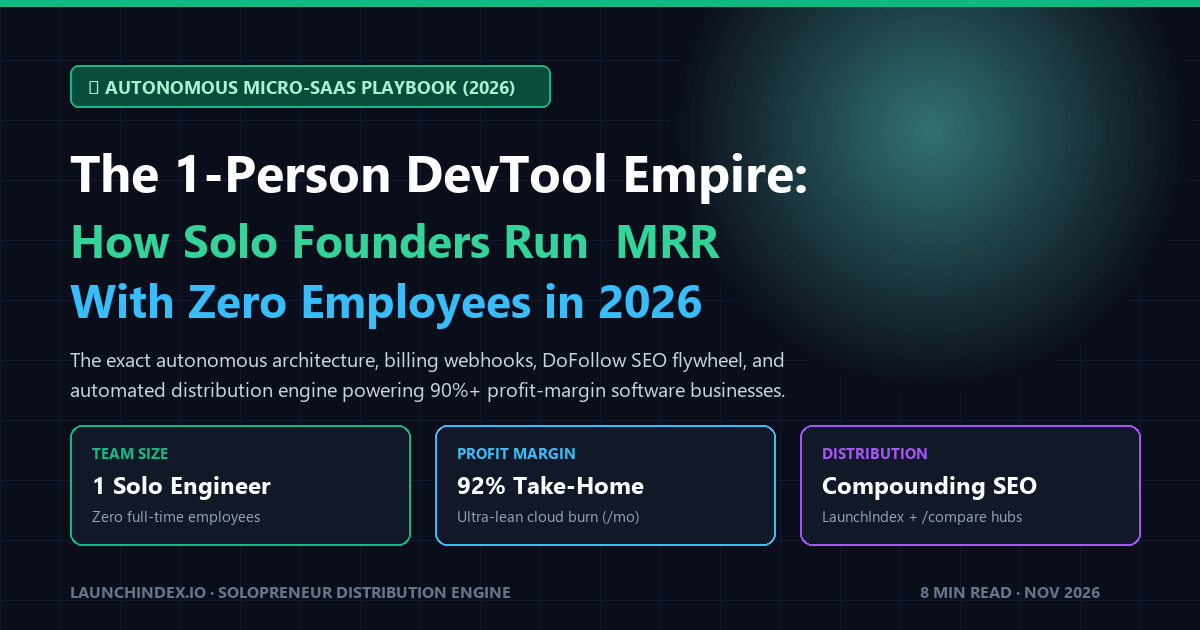
A new breed of technical founder—the 1-Person DevTool Empire—is scaling single-utility products, CLI companions, API micro-services, and self-hosted tools to $10,000–$30,000 MRR with zero employees and profit margins exceeding 92%.
How? By treating automation, self-hosting, and compounding distribution as non-negotiable architectural primitives.
Here is the exact technical stack, operational automation loop, and customer acquisition engine powering modern solo software empires in 2026.
The 4 Architectural Layers of a 1-Person DevTool
To run a software company without employees, your architecture must be autonomous by design. If an outage or customer issue requires a 2:00 AM manual intervention, your business model breaks.
┌────────────────────────────────────────────────────────┐
│ 1. Ingestion & Core Product (Zero-Maintenance Infra)   │
│ - Single-binary Go / Rust backend or Next.js App Router│
│ - Embedded SQLite (WAL mode) on NVMe ($40/mo VPS)       │
│ - Zero external connection pooling or RDS overhead     │
└────────────────────────────────────────────────────────┘
                           │
                           ▼
┌────────────────────────────────────────────────────────┐
│ 2. Autonomous Revenue Engine (Webhooks & Licensing)    │
│ - Whop / Stripe Checkout webhook handlers              │
│ - Instant automated token generation & receipt delivery │
│ - Self-serve tier upgrades & customer portal           │
└────────────────────────────────────────────────────────┘
                           │
                           ▼
┌────────────────────────────────────────────────────────┐
│ 3. Automated Maker Outreach & Retention                │
│ - Transactional Resend email sequences                 │
│ - Automated weekly telemetry digests                   │
│ - Self-healing cron workers on Cloud Run               │
└────────────────────────────────────────────────────────┘
                           │
                           ▼
┌────────────────────────────────────────────────────────┐
│ 4. Compounding Inbound Distribution (LaunchIndex Engine)│
│ - Permanent DoFollow backlink equity                   │
│ - Programmatic /compare comparison matrices            │
│ - Direct syndication into /llms.txt and MCP for AI     │
└────────────────────────────────────────────────────────┘
Layer 1: The Zero-Maintenance Compute Core
Solo founders don't use Kubernetes. They deploy using PocketBase or a lightweight Docker Compose cluster managed by Coolify:
- Why? An embedded SQLite database running in WAL mode on an NVMe drive can easily handle 30,000+ reads/sec with zero TCP connection pooling bottlenecks.
- Backups: Litestream streams every WAL frame to Cloudflare R2 in real time. If the server dies, restoring takes 20 seconds.
- Hosting Bill: Under $50/month total across all compute and storage.
Layer 2: Headless Commerce & Instant Fulfillment
Manual invoicing kills solopreneurs. Modern devtools use unified webhook handlers listening to Stripe or Whop events:
- When a buyer purchases a Verified Launch or Pro License, a webhook triggers:
- The database flips the tool's status to
verified_status = 'verified_launch'. - A cryptographic license key or claim token is minted.
- The maker is redirected to their self-serve management portal.
- The database flips the tool's status to
- Zero human emails. Zero manual license provisioning.
Layer 3: Autonomous Transactional Sequences
When a new tool or developer joins your platform, automated transactional sequences via Resend or Postmark handle the lifecycle:
- Day 0: Onboarding confirmation and verified badge embed code.
- Day 3: Notification when their tool is indexed in the weekly cohort.
- Day 7: Automated traffic summary and upvote leaderboard report.
The Distribution Engine: Why Serial Solopreneurs Use the LaunchIndex Maker Pass
The greatest bottleneck for a solo founder is not writing code—it is marketing while building. If you spend 20 hours a week doing manual outbound sales, your product velocity stops.
Successful solo builders leverage LaunchIndex's Compounding Distribution Network:
- Permanent DoFollow Backlinks: Breaking out of the Google/Bing DR-0 sandbox immediately.
- Programmatic Comparison Hub: Every tool is automatically paired against competitors in our Software Comparison Hub (
/compare), intercepting high-intent buyers searching for alternatives. - Machine-Readable AI Distribution: Every listing is formatted into
SoftwareApplicationJSON-LD schema and syndicated into/llms.txtand our live Model Context Protocol (/api/mcp) server.
For developers shipping multiple micro-SaaS apps, developer utilities, and CLI tools, the LaunchIndex Maker Pass provides unlimited verified launches, permanent DoFollow equity, and priority cohort placement across your entire product portfolio for a one-time pass.
Summary Checklist for the 1-Person DevTool Founder
- Pick a Single, Sharp Pain Point: Don't build an all-in-one platform. Build the best, fastest, or most lightweight tool for one specific job.
- Keep Infrastructure Costs Under $60/Mo: Run on dedicated VPS nodes with embedded SQLite and S3 backups. Never pay managed cloud markup before PMF.
- Automate All Commerce & Fulfillment: Wire Stripe/Whop webhooks to self-serve portals on Day 1.
- Build Compounding Distribution Equity: Get verified on LaunchIndex to secure your permanent DoFollow backlink and bottom-of-funnel comparison pages.